


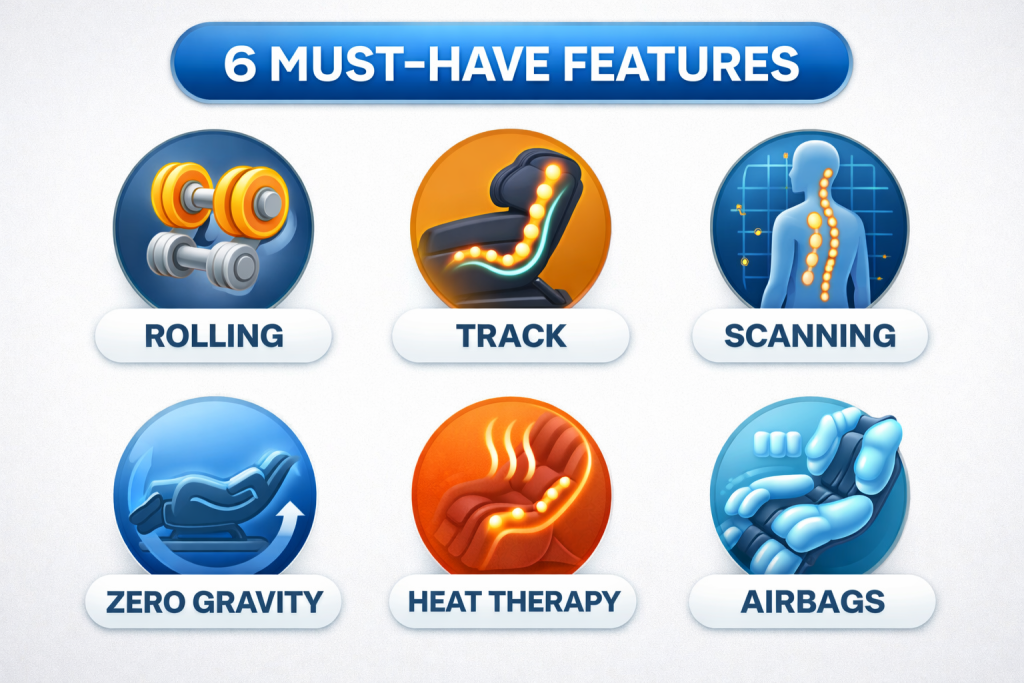
Walk into any massage chair showroom — or browse online — and you’ll be hit with a dizzying list of features: 3D rollers, L-Track, zero gravity, body scanning, airbags, heat therapy, Bluetooth speakers, voice control, and more.
But here’s the truth: Not all features matter equally. Some are essential for pain relief. Others are nice-to-have luxuries. And a few are complete marketing gimmicks.
In this guide, we’ll break down every major massage chair feature into three categories: Must-Have, Nice-to-Have, and Gimmick. By the end, you’ll know exactly what to look for — and what to ignore.
Quick Summary: Features at a Glance
| Feature | Importance | Why It Matters | Skip If… | Minimum Standard |
|---|---|---|---|---|
| Roller Technology (2D/3D/4D) | 🔴 Must-Have | Determines massage depth & quality | Budget under $1,500 | 3D recommended |
| Track Type (S/L/SL/J) | 🔴 Must-Have | Determines coverage area (glutes/hamstrings) | Upper back pain only | SL-Track |
| Body Scanning | 🔴 Must-Have | Customizes massage to your height/shape | Only you use chair (still recommended) | Basic spine mapping |
| Zero Gravity | 🔴 Must-Have | Reduces spine pressure, enhances massage | Very limited space | At least 1 stage |
| Heat Therapy | 🔴 Must-Have | Loosens tight muscles, improves circulation | Live in hot climate | Lumbar heat |
| Airbag System | 🔴 Must-Have | Compression massage for arms, legs, shoulders | None — all chairs need airbags | Shoulders + arms + calves + feet |
| Auto Programs | 🟡 Nice-to-Have | Convenience for different needs | Prefer manual control | 5+ programs |
| Foot & Calf Massage | 🟡 Nice-to-Have | Relieves plantar fasciitis, leg fatigue | No foot/leg issues | Air compression + rollers |
| Space Saving Design | 🟡 Nice-to-Have | Allows placement closer to wall | Have dedicated large room | 2-4 inches from wall |
| Bluetooth Speakers | ⚪ Gimmick | Plays music — but phone speakers work fine | Don’t care about music | None — not important |
| Voice Control | ⚪ Gimmick | Convenience but often buggy | Prefer remote control | Not needed |
| Chromotherapy (LED Lights) | ⚪ Gimmick | Color lights — zero therapeutic value | Any budget | Ignore completely |
The 6 Must-Have Features (Non-Negotiable)
These features are essential for a therapeutic, effective, and safe massage experience. Do not buy a chair missing any of these.
1. Roller Technology: 3D or Higher
Why it’s essential: Rollers are the heart of the massage chair. They determine how deep, how intense, and how effective the massage feels.
- Avoid: 2D rollers (fixed pressure) or vibration-only chairs
- Minimum: 3D rollers with adjustable depth (at least 3 intensity levels)
- Ideal: 3D or 4D rollers with 5+ intensity levels
Red flag: If a chair under $1,500 claims “3D rollers” — it’s likely fake (vibration motors). Real 3D roller mechanisms cost more to manufacture.
📖 Related: 3D vs 4D Massage Chairs: Complete Guide
2. Track Type: SL-Track (or L-Track for Lower Back Pain)
Why it’s essential: The track determines how much of your body gets massaged. S-Track chairs stop at your lower back — missing glutes and hamstrings, which are often the root cause of lower back pain.
- Avoid: Straight track (old technology)
- Minimum for lower back pain: L-Track or SL-Track
- Ideal: SL-Track (spine-hugging curve + glute/hamstring coverage)
For upper back pain only: S-Track may suffice, but SL-Track is still better.
📖 Related: L-Track vs S-Track: What’s the Difference?
3. Body Scanning Technology
Why it’s essential: Without body scanning, the rollers follow a generic path that may not match your spine. If you’re tall, short, or have unusual proportions, the massage could miss your shoulders or press on your tailbone.
How it works: The chair uses sensors to map your:
- Shoulder height and position
- Spine curvature
- Body width
Then it adjusts the roller path specifically to your body.
- Avoid: Chairs without any body scanning (common under $2,000)
- Minimum: Basic shoulder-position detection
- Ideal: AI-powered scanning that detects tension areas
Note: If only one person uses the chair and you’re average height (5’6″–5’10”), you can maybe skip body scanning — but it’s still strongly recommended.
4. Zero Gravity Recline
Why it’s essential: Zero gravity position (inspired by NASA) reclines your body so your knees are above your heart. This:
- Reduces pressure on your spine by up to 80%
- Improves circulation
- Allows rollers to penetrate deeper muscles
- Creates a floating, weightless sensation
- Avoid: Chairs without any zero gravity function
- Minimum: Single-stage zero gravity
- Ideal: Two-stage or three-stage zero gravity (different recline angles)
Space consideration: Zero gravity requires the chair to recline backward. Standard chairs need 12–20 inches of wall clearance. Space-saving designs need only 2–4 inches — worth paying extra for if space is tight.
5. Heat Therapy (At Least Lumbar)
Why it’s essential: Heat is not a luxury — it’s therapeutic. Heat:
- Increases blood flow to tight muscles
- Makes muscle tissue more pliable (better roller penetration)
- Reduces stiffness and morning back pain
- Accelerates healing of muscle strains
- Avoid: Chairs without any heat function
- Minimum: Lumbar (lower back) heat pads
- Ideal: Lumbar + calf + foot heat (or heated rollers for deeper penetration)
Warning: Some cheap chairs advertise “heat” but it’s a tiny, barely-warm pad. Look for chairs with carbon fiber heating elements (heat up faster, distribute evenly).
6. Comprehensive Airbag System
Why it’s essential: Rollers work your back. Airbags work everything else — shoulders, arms, hips, thighs, calves, and feet. Airbags provide compression massage that:
- Reduces fluid retention
- Improves lymphatic drainage
- Relieves muscle tension in hard-to-reach areas
Minimum airbag coverage:
- ✅ Shoulders (both sides)
- ✅ Arms (full length)
- ✅ Calves
- ✅ Feet
Ideal airbag coverage: Adds hips, thighs, and hands.
Red flag: Chairs under $1,500 often have only 4–6 small airbags. Look for chairs with 10+ airbags for full-body compression.
🎯 The Non-Negotiable Six: 3D+ rollers • SL-Track • Body scanning • Zero gravity • Heat therapy • Full airbag system. If a chair is missing any of these, keep shopping.
The 4 Nice-to-Have Features (Worth Paying Extra For)
These features aren’t essential, but they significantly improve the experience. If your budget allows ($3,000+), look for them.
1. Auto Programs (6+ Programs)
Auto programs are pre-set massages for specific needs: “Morning Wake-Up,” “Deep Tissue,” “Relaxation,” “Sports Recovery,” etc.
Why it’s nice-to-have: Convenience. Instead of manually adjusting rollers, speed, airbags, and heat, you push one button.
- Minimum: 5–6 auto programs
- Ideal: 12–20+ programs including stretch programs
Don’t overvalue this: Even with 20 programs, most people use the same 2–3 favorites. Quality of programs matters more than quantity.
2. Foot & Calf Massage with Rollers
Basic chairs have airbags only in the leg rest — they squeeze your calves and feet. Better chairs add rotating rollers under your feet (reflexology) and sometimes rollers for calves.
Why it’s nice-to-have:
- Amazing for plantar fasciitis (heel pain)
- Relieves tired, swollen feet after standing or walking
- Rollers provide deeper pressure than airbags alone
Who should prioritize this: Runners, nurses, retail workers, anyone on their feet all day, people with plantar fasciitis.
3. Space-Saving / Wall-Hugging Design
Traditional massage chairs need 12–20 inches of clearance behind them to recline fully. Space-saving designs need only 2–4 inches.
Why it’s nice-to-have: Lets you place the chair in smaller rooms, offices, or bedrooms without sacrificing zero gravity recline.
- Minimum: 8 inches of clearance (standard)
- Ideal: 2–4 inches (space-saving)
Worth paying $300–$500 extra for space-saving? Yes — if you don’t have a dedicated large room. Many mid-range chairs ($3,000–$5,000) now include this standard.
4. Stretch Programs (Yoga-Style Stretching)
Higher-end chairs include stretch programs where the chair gently stretches your body — pulling your legs while holding your shoulders, or arching your back.
Why it’s nice-to-have: Stretching increases flexibility, decompresses the spine, and feels amazing after sitting all day.
Who should prioritize this: People with spinal disc issues (under doctor guidance), athletes, anyone with general stiffness.
The 3 Features You Can Ignore (Marketing Gimmicks)
These features add cost but little to no therapeutic value. Don’t pay extra for them.
1. Bluetooth Speakers
The marketing claim: “Immerse yourself in music while you relax!”
The reality: The speakers are usually low-quality (worse than your phone). You already have headphones, earbuds, or a Bluetooth speaker that sounds better.
Verdict: Nice if included for free. Never pay extra for it. Your phone on the armrest works fine.
2. Voice Control (Alexa / Google Assistant)
The marketing claim: “Control your massage hands-free!”
The reality: Buggy, slow, and frustrating. You’ll say “Alexa, start deep tissue massage” three times before it works. The physical remote is faster and more reliable.
Verdict: Completely unnecessary. Most owners try it once, then never again.
3. Chromotherapy (Color LED Lights)
The marketing claim: “Colored lights balance your chakras and enhance healing!”
The reality: Zero scientific evidence that colored lights in a massage chair have any therapeutic effect. It’s just pretty (or annoying) lighting.
Verdict: Ignore completely. If a chair costs more because of “chromotherapy,” walk away.
⚠️ Pro tip: Some manufacturers add gimmicks like Bluetooth, voice control, and LED lights to distract from poor core features (bad rollers, short track, weak airbags). Always prioritize the must-have features first.
Features by Price Tier: What to Expect
Here’s what features you get at each price point — and what you’re missing.
Under $1,500 (Entry Level)
- ❌ 2D rollers (fixed pressure) or vibration-only
- ❌ Straight track or S-Track (usually poor quality)
- ❌ No body scanning (or very basic)
- ⚠️ Zero gravity? Rare and poorly executed
- ⚠️ Heat? Sometimes, but low quality
- ⚠️ 4–6 small airbags (limited coverage)
- ✅ 3–5 auto programs
Verdict: Better than nothing, but not therapeutic. Save longer for $2,500+.
$1,500 – $3,000 (Budget)
- ✅ 2D or entry-level 3D rollers
- ✅ S-Track (good) or basic L-Track
- ✅ Basic body scanning (shoulder detection)
- ✅ Single-stage zero gravity
- ✅ Lumbar heat (basic)
- ✅ 6–10 airbags (shoulders, arms, calves)
- ✅ 5–8 auto programs
Verdict: Acceptable for occasional use (3–4x/week). Good for first-time buyers.
$3,000 – $5,000 (Mid-Range — SWEET SPOT)
- ✅ True 3D rollers (3–5 intensity levels)
- ✅ SL-Track (spine curve + glutes/hamstrings)
- ✅ Advanced body scanning (spine mapping + width)
- ✅ Two-stage zero gravity
- ✅ Lumbar + calf heat (carbon fiber)
- ✅ 12–20 airbags (full body)
- ✅ 8–12 auto programs + stretch programs
- ✅ Foot rollers (reflexology)
- ✅ Space-saving design (often included)
Verdict: The sweet spot for most buyers. 90% of luxury features at half the price.
$5,000 – $8,000+ (Premium to Luxury)
- ✅ 4D rollers (speed + rhythm variation)
- ✅ SL-Track or J-Track (extends to calves)
- ✅ AI body scanning (tension detection)
- ✅ Three-stage zero gravity
- ✅ Heated rollers + multiple heat zones
- ✅ 20–30+ airbags with adjustable zones
- ✅ 15–25+ auto programs
- ✅ Full leg rollers (calves + feet)
- ✅ Advanced stretch programs (spinal decompression)
- ✅ Voice control (if you want it — still gimmicky)
Verdict: For enthusiasts or medical needs. Excellent but expensive.
Features for Specific Needs
Different health conditions benefit from different features. Here’s what to prioritize based on your situation.
For Lower Back Pain
- Priority #1: SL-Track or L-Track (must massage glutes)
- Priority #2: Lumbar heat therapy
- Priority #3: 3D rollers (adjustable depth)
- Nice-to-have: Stretch programs (spinal decompression)
For Sciatica (Pain Down Leg)
- Priority #1: L-Track or SL-Track (glute massage is essential — sciatic nerve runs through glutes)
- Priority #2: Airbags for hips and thighs
- Priority #3: Adjustable intensity (start low)
- Avoid: Deep tissue programs (can aggravate sciatica)
For Neck & Shoulder Pain
- Priority #1: Good body scanning (rollers must find your shoulders)
- Priority #2: Shoulder airbags (compression)
- Priority #3: 3D rollers with low intensity option
- Nice-to-have: Targeted neck programs
For Plantar Fasciitis / Foot Pain
- Priority #1: Foot rollers (rotating, not just airbags)
- Priority #2: Calf airbags + rollers
- Priority #3: Heat in footrest
- Nice-to-have: Reflexology programs
For Seniors / Elderly
- Priority #1: Easy-to-use remote (large buttons, clear display)
- Priority #2: Low intensity option (gentle massage)
- Priority #3: Easy entry/exit (wide opening, sturdy armrests)
- Priority #4: Heat therapy (arthritic joints benefit)
- Nice-to-have: Voice control (if mobility issues make remote hard to use)
For Athletes (Post-Workout Recovery)
- Priority #1: Deep tissue capability (3D or 4D rollers at high intensity)
- Priority #2: Full leg massage (calves + thighs + feet)
- Priority #3: Stretch programs
- Priority #4: Multiple intensity levels (for different sports/muscles)
Feature Comparison: Top Brands
| Brand | Rollers | Track | Body Scan | Heat | Airbags | Price Range | Best For | Warranty | Best Model |
|---|---|---|---|---|---|---|---|---|---|
| Osaki | 3D/4D | SL-Track | ✅ Advanced | ✅ Lumbar + Calf | 20-30 | $3k–$8k | Overall value | 3 years | OS-4D Escape |
| Kahuna | 3D | SL-Track | ✅ Advanced | ✅ Lumbar | 20-25 | $3k–$5k | Tall users | 3 years | Superior |
| Titan | 3D | L-Track | ✅ Basic | ✅ Lumbar | 15-20 | $2.5k–$4k | Budget 3D | 2-3 years | Pro Jupiter |
| Human Touch | 3D/4D | SL-Track | ✅ Advanced | ✅ Lumbar | 15-20 | $4k–$8k | Furniture design | 2-5 years | Super Novo |
| Inada | 4D | J-Track | ✅ AI | ✅ Heated rollers | 25-30 | $8k–$12k | Luxury/medical | 5 years | Sogno DreamWave |
| Luraco | 4D | J-Track | ✅ AI | ✅ Heated rollers+feet | 30+ | $10k–$13k | Made in USA, warranty | 7 years (best) | iRobotics 7 |
Feature Checklist: Print or Save This Before Shopping
Copy this checklist and take it with you to a showroom or keep it open while shopping online.
🔴 MUST-HAVE (Check all that apply):
- □ 3D rollers or higher (adjustable depth) — 2D is NOT acceptable
- □ SL-Track or L-Track (must cover glutes for lower back pain)
- □ Body scanning technology (spine mapping)
- □ Zero gravity recline (at least 1 stage)
- □ Heat therapy (at least lumbar)
- □ Airbags for: shoulders ☐ arms ☐ calves ☐ feet ☐
🟡 NICE-TO-HAVE (Prioritize if budget allows):
- □ 6+ auto programs (including stretch programs)
- □ Foot rollers (reflexology)
- □ Space-saving design (2–4 inches from wall)
- □ Calf rollers (not just airbags)
- □ Multiple heat zones (lumbar + calves + feet)
- □ Easy entry/exit (for seniors or mobility issues)
⚪ IGNORE (Don’t pay extra for these):
- □ Bluetooth speakers
- □ Voice control (Alexa/Google)
- □ Chromotherapy (LED lights)
- □ “5D, 6D, 7D, 8D” claims — all marketing gimmicks
📋 Final checks:
- □ Warranty: At least 3 years on parts, 5+ years on frame
- □ White glove delivery included? (assembly can be difficult)
- □ Return policy: At least 30 days with low or no restocking fee
- □ Fits your height and weight (check manufacturer specs)
- □ Fits your room (measure doorways and space)
Frequently Asked Questions
What’s the single most important feature in a massage chair?
Roller technology (3D or higher) and track type (SL-Track) are equally important. The rollers determine how you’re massaged; the track determines where. If you have lower back pain, prioritize SL-Track first. If you want deep tissue, prioritize 3D rollers first.
Are expensive massage chairs worth it?
Yes, up to a point. The jump from $1,500 to $4,000 is huge — you go from basic 2D/S-Track to 3D/SL-Track with full airbags and heat. The jump from $4,000 to $8,000+ is smaller — mainly 4D rollers, J-Track, and gimmicks. For most people, $3,000–$5,000 is the sweet spot.
Do I really need body scanning?
Yes — unless you’re the only user and perfectly average height. Body scanning ensures the rollers hit your shoulders (not your neck) and your lower back (not your tailbone). Without it, the massage follows a generic path that may not fit your body.
Is heat therapy really necessary?
For lower back pain, yes, absolutely. Heat loosens tight muscles, increases blood flow, and makes the roller massage more effective. For general relaxation? Nice but not essential.
What’s the difference between 3D and 4D rollers?
3D adds depth/pressure control. 4D adds speed and rhythm variation (more human-like). For most people, 3D is sufficient. Read our full guide: 3D vs 4D Massage Chairs.
Conclusion: Focus on the Must-Haves First
When shopping for a massage chair, it’s easy to get distracted by flashy gimmicks — Bluetooth speakers, voice control, colorful lights. Don’t fall for it.
Focus relentlessly on the six must-have features:
- 3D+ rollers (adjustable depth)
- SL-Track (spine curve + glute coverage)
- Body scanning (custom fit)
- Zero gravity (pressure relief)
- Heat therapy (muscle loosening)
- Comprehensive airbags (full-body compression)
If a chair has all six, it will provide excellent therapeutic value. Then, if your budget allows, add nice-to-haves like foot rollers, space-saving design, and stretch programs.
And remember: The best massage chair is the one you’ll actually use. A $4,000 chair used daily is better than a $10,000 chair that sits in the corner. Prioritize quality core features, test before you buy if possible, and invest in the best chair you can reasonably afford.
📌 Related guides in this series: