


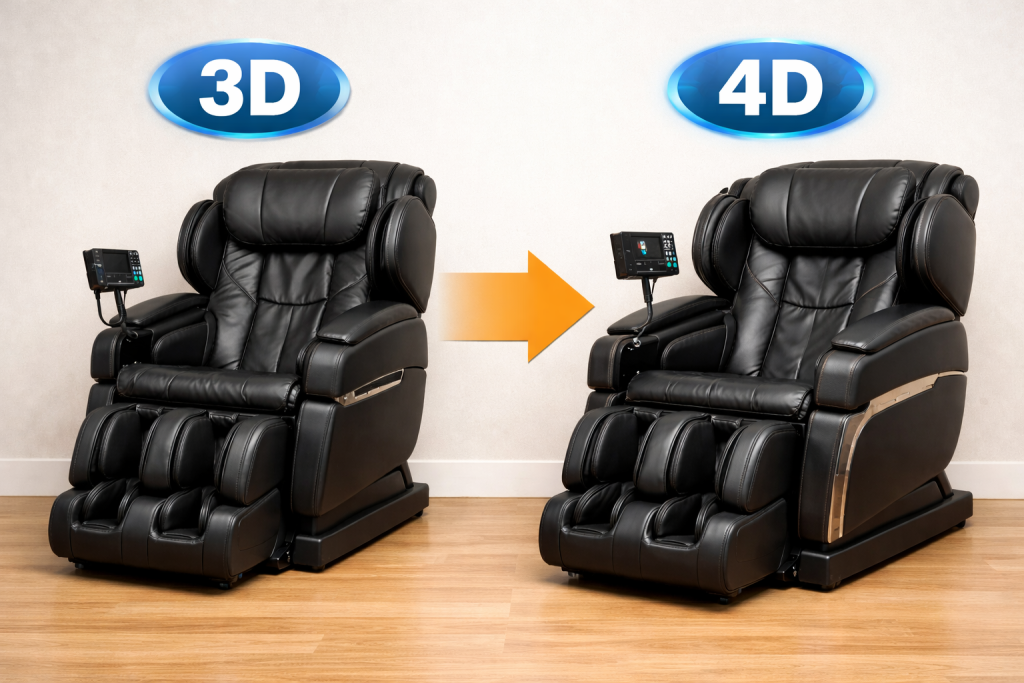
If you’ve started shopping for a massage chair, you’ve probably seen terms like 2D, 3D, and 4D roller technology — and the price differences can be huge (from $1,500 to over $10,000).
So what’s the real difference between 3D vs 4D massage chairs? Is 4D worth the extra money? Or is 3D good enough for most people?
In this guide, we’ll break down exactly what these terms mean, how they feel during a massage, and help you decide which technology is right for your budget and needs.
Quick Answer: 3D vs 4D at a Glance
| Feature | 2D (Entry Level) | 3D (Mid-Range) | 4D (Premium/Luxury) | 5D (Marketing Term) | 6D+ (Marketing Term) |
|---|---|---|---|---|---|
| Movements | Up/Down + Left/Right | + In/Out (depth) | + Speed/Rhythm variation | Same as 4D | Marketing gimmick |
| Intensity control | Fixed | Manual (3-5 levels) | Automatic + Manual | Same as 4D | None |
| Feels like | Robot pushing | Human-like pressure | Human hands with rhythm | Same as 4D | Fake |
| Price range | $1,500–$3,000 | $3,000–$6,000 | $6,000–$12,000+ | N/A (avoid) | N/A (avoid) |
| Best for | Budget buyers, light use | Daily users, back pain | Enthusiasts, medical needs | Avoid entirely | Avoid entirely |
What Do the “D”s Actually Mean?
First, let’s demystify the terminology. The “D” stands for dimension — referring to the directions the massage rollers can move.
2D Massage Chairs: Basic Up/Down + Left/Right
2D rollers move in two directions:
- Up and down along your spine
- Left and right across your back
The pressure is fixed — you cannot adjust how deep the rollers push into your muscles. This creates a “one-size-fits-all” massage that may feel too light for some people or too intense for others.
Verdict: Fine for occasional use, but most buyers quickly outgrow 2D chairs.
3D Massage Chairs: Adds In/Out Depth Control
3D rollers add a third dimension: in and out (depth/pressure).
- You can manually adjust how deep the rollers press into your muscles
- Typically 3–5 intensity levels (e.g., 1=gentle, 5=deep tissue)
- Creates a much more customizable experience
Verdict: The sweet spot for most buyers. 3D technology gives you deep tissue power when you need it, gentle pressure when you don’t.
4D Massage Chairs: Adds Speed & Rhythm Variation
4D rollers take 3D and add control over timing and rhythm.
- The rollers change speed during the massage (fast tapping, slow kneading)
- The rhythm varies — sometimes fast and shallow, sometimes slow and deep
- Some 4D chairs automatically adjust based on your muscle tension (AI-driven)
Verdict: The most “human-like” experience. The massage feels alive, not mechanical. Worth it for daily users who want variety.
5D, 6D, 7D, 8D — What About Those?
Marketing gimmick. Pure and simple.
There is no 5th, 6th, or 7th dimension of roller movement. These terms were invented by low-quality manufacturers (mostly from certain overseas factories) to make their chairs sound more advanced than they are.
A chair labeled “5D” or “8D” is almost always inferior to a real 3D or 4D chair from a reputable brand. Avoid these entirely.
⚠️ Red flag: If you see a massage chair advertised as “5D,” “6D,” “7D,” or “8D” for under $2,000 — it’s almost certainly a low-quality chair with vibration motors, not real roller technology. Run away.
How 3D and 4D Feel Different: A Real-World Comparison
Let’s describe the actual sensation of each technology.
The 3D Experience
Imagine a pair of thumbs pressing into your back. The pressure is consistent and steady. You can make it lighter (like a Swedish massage) or deeper (like a deep tissue massage). But the rhythm stays relatively constant — the rollers move at the same speed throughout each stroke.
Best analogy: A skilled massage therapist using the same technique repeatedly. Very effective, but predictable.
The 4D Experience
Now imagine those same thumbs, but they vary their speed and pressure moment by moment. Sometimes they tap quickly to wake up your muscles. Sometimes they press slowly and deeply to release a knot. The rhythm changes — fast then slow, shallow then deep, like a musical composition.
Best analogy: A master massage therapist who reads your body and varies their technique continuously. Less predictable, more engaging, more human-like.
Feature Comparison: 3D vs 4D Massage Chairs
| Feature | 3D Massage Chair | 4D Massage Chair |
|---|---|---|
| Depth/pressure control | ✅ Manual (3-5 levels) | ✅ Manual + automatic |
| Speed variation | ❌ Fixed speed per program | ✅ Varies during session |
| Rhythm changes | ❌ Predictable pattern | ✅ Dynamic, unpredictable |
| AI body scanning | Basic (spine mapping) | Advanced (tension detection + auto-adjust) |
| Auto programs count | 6–12 programs | 15–25+ programs |
| Manual customization | Good | Excellent (speed, width, depth, rhythm) |
| Human-like feel | ⭐⭐⭐ Good | ⭐⭐⭐⭐⭐ Excellent |
Which One Should You Buy? A Decision Guide
Answer these questions to find your ideal technology level.
✅ Choose 2D (Entry Level) If:
- Your budget is under $3,000
- You’ll use the chair 1–3 times per week
- You don’t have chronic pain or specific muscle issues
- You’re buying for a child, teen, or elderly person with light use only
- You’ve never owned a massage chair and want to test the waters
Best 2D brands: Real Relax, BestMassage, some lower-end Kahuna models
✅ Choose 3D (Mid-Range — Recommended for Most) If:
- Your budget is $3,000–$6,000
- You’ll use the chair daily or almost daily
- You have mild to moderate back pain, muscle tension, or stress
- You want deep tissue capability without paying luxury prices
- You want the chair to last 7–10 years
Best 3D brands: Osaki (OS-4D Escape), Kahuna (Superior), Titan (Pro Jupiter), Human Touch (Super Novo — often on sale)
🎯 For 80% of buyers, 3D is the right answer. You get adjustable depth/pressure, excellent build quality, and a chair that feels great daily — all without the $6,000+ price tag of 4D.
✅ Choose 4D (Premium/Luxury) If:
- Your budget is $6,000+ (ideally $8,000–$12,000)
- You’re a massage enthusiast who wants the most human-like experience
- You have chronic pain conditions that require varied techniques (e.g., fibromyalgia, arthritis, multiple pain sites)
- Multiple family members with different preferences will use the chair daily
- You want the absolute best technology available today
- You plan to keep the chair for 10–15+ years
Best 4D brands: Inada (Sogno DreamWave), Panasonic (Real Pro Ultra), Luraco (iRobotics 7), Osaki (Pro Maestro), Daiwa (Hybrid)
Real Owner Experiences: 3D vs 4D
3D Owner Review (Kahuna Superior, $4,500)
“I’ve had my 3D chair for 2 years and use it almost daily for lower back pain. The depth control is fantastic — I can go gentle on sensitive days or deep when my back is really tight. Do I wish I had 4D? Sometimes. But for $4,500 vs $9,000, the 3D does everything I need. My back pain has decreased by about 70%.” — Mark, 52
4D Owner Review (Inada Sogno DreamWave, $8,999)
“Yes, it’s expensive. But after trying both 3D and 4D in a showroom, I couldn’t go back. The 4D feels like a human therapist — the rhythm changes constantly, so you never get bored or ‘used to’ the massage. My wife and I both use it daily. For us, the extra $4,000 was worth it for 10+ years of enjoyment.” — Sarah, 47
Is 4D Worth the Extra Cost? A Cost-Benefit Analysis
Let’s do the math. Assume you keep the chair for 10 years and use it 300 days per year.
| Chair Type | Average Price | Cost Per Use (10 years, 300 uses/year) |
|---|---|---|
| 2D (Entry) | $2,000 | $0.67 per session |
| 3D (Mid-Range) | $4,500 | $1.50 per session |
| 4D (Luxury) | $9,000 | $3.00 per session |
Comparison to professional massage: A 60-minute professional massage costs $80–$150. Even the 4D chair at $3 per session is 95% cheaper than seeing a therapist weekly.
Verdict: All three options are dramatically cheaper than professional massage. The question isn’t whether a chair pays for itself — it does, within months. The question is whether the incremental improvement from 3D to 4D is worth an extra $4,500 to you.
Common Myths About 3D and 4D Massage Chairs
Myth #1: “Higher D is always better”
False. A high-quality 3D chair from a reputable brand (Osaki, Kahuna, Titan) is far better than a cheap “5D” chair from an unknown manufacturer. Focus on brand reputation, warranty, and real roller technology — not the D number.
Myth #2: “4D is just marketing hype”
Partially true, partially false. Real 4D from established brands (Inada, Panasonic, Luraco) is a genuine technology with speed and rhythm control. However, many cheap chairs claim “4D” when they’re actually 2D with vibration. Always verify with a reputable dealer.
Myth #3: “You need 4D for deep tissue massage”
False. 3D chairs provide plenty of depth for deep tissue work. The difference is in rhythm variation, not maximum pressure. A 3D chair at level 5 intensity is very deep.
How to Test 3D vs 4D in a Showroom
If possible, visit a showroom like Relax The Back, The Massage Chair Store, or a local dealer. Here’s what to do:
- Test a 3D chair first — set intensity to level 3 (medium). Pay attention to how consistent the rhythm feels.
- Then test a 4D chair — notice how the speed and rhythm change during the session. Does it feel more engaging?
- Ask to test the same body area (e.g., lower back) on both chairs for 5 minutes each.
- Blind test — have someone else set up the chairs without telling you which is which. See if you can consistently identify the 4D chair.
Many people find that while 4D feels “nicer,” the 3D chair still provides 90% of the therapeutic benefit. Some can’t tell the difference at all.
Top 3D and 4D Massage Chairs by Category
Best 3D Massage Chairs ($3,000–$6,000)
| Model | Price (approx) | Best For | Key Feature |
|---|---|---|---|
| Osaki OS-4D Escape | $3,999 | Overall best value | 4D name but true 3D tech |
| Kahuna Superior | $4,499 | Tall users (6’4″) | Extra-long L-track |
| Titan Pro Jupiter | $3,499 | Budget 3D | Space-saving design |
| Human Touch Super Novo | $4,999 (on sale) | Furniture design | Looks like regular chair |
Best 4D Massage Chairs ($6,000–$12,000+)
| Model | Price (approx) | Best For | Key Feature |
|---|---|---|---|
| Inada Sogno DreamWave | $8,999 | Most human-like | Wave motion technology |
| Panasonic Real Pro Ultra | $9,999 | Juniper (medical) rollers | FDA registered (medical device) |
| Luraco iRobotics 7 | $11,999 | Made in USA | 7-year warranty, US support |
| Osaki Pro Maestro | $7,999 | Value 4D | AI body scan |
Frequently Asked Questions
Is 4D worth the extra money?
For most people, no — a good 3D chair provides 90% of the benefit at 50% of the price. For enthusiasts, chronic pain sufferers, or those who want the absolute best, yes.
Can I feel the difference between 3D and 4D?
Most people can, but it’s subtle. The 4D feels more “alive” and varied. However, some people actually prefer the predictable consistency of 3D. Test both before deciding.
Do I need 4D for medical conditions?
Not necessarily. 3D chairs are used successfully by thousands of people with chronic back pain, sciatica, and arthritis. However, some conditions (like fibromyalgia with multiple tender points) may benefit from 4D’s varied rhythm. Ask your doctor or physical therapist.
Why are some “4D” chairs only $2,000?
They’re lying. A real 4D roller system from a reputable manufacturer costs significantly more to produce. Those cheap “4D” chairs use vibration motors or very basic 2D rollers with marketing labels. Avoid them.
Which brand has the best 4D technology?
Inada (Japan) is widely considered the gold standard for 4D, followed by Panasonic (Japan) and Luraco (USA). These brands have been innovating for decades.
Conclusion: 3D vs 4D — Which Should You Choose?
🎯 For most buyers: Choose a 3D massage chair in the $3,000–$5,000 range. You’ll get adjustable depth/pressure, excellent build quality, and a chair that handles daily use for 7–10 years — all without paying the luxury premium for 4D.
Choose 4D only if: You have the budget ($6,000+), you’re a massage enthusiast, or you’ve tested both and truly prefer the dynamic rhythm of 4D.
Avoid anything labeled “5D,” “6D,” “7D,” or “8D” — these are marketing gimmicks on low-quality chairs.
Remember: The best massage chair is the one you’ll actually use. A well-built 3D chair used daily is infinitely better than a luxury 4D chair that sits in the corner because you couldn’t afford it comfortably.
📌 Related guides: