


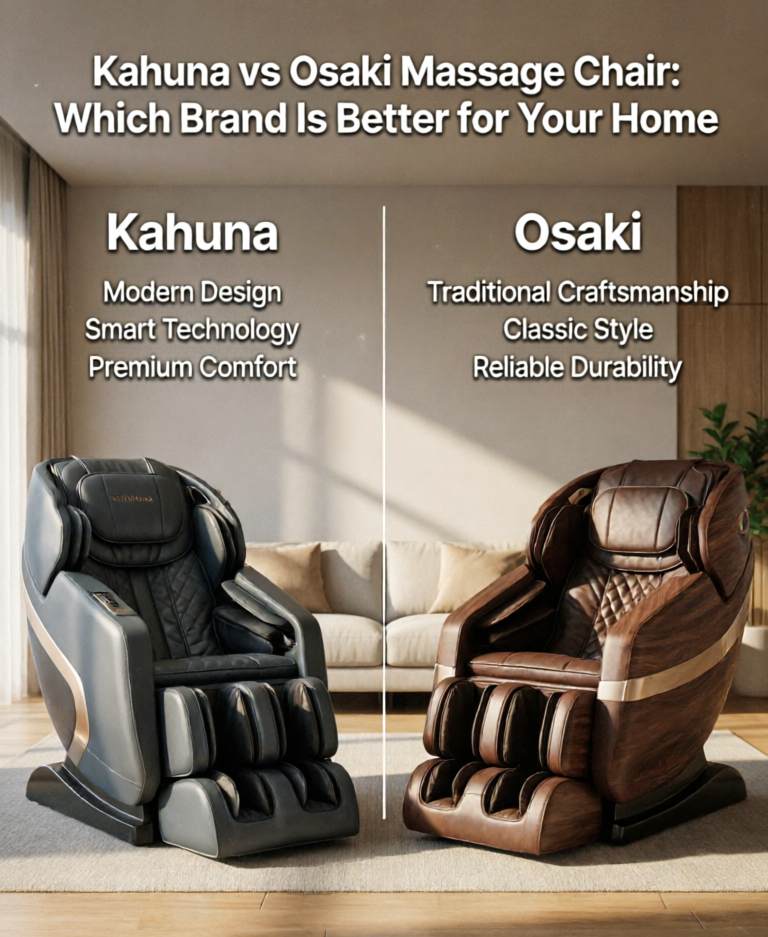
When shopping for a high-quality massage chair, two names consistently rise to the top: Kahuna and Osaki. Both brands are beloved by home users and wellness enthusiasts, but they take very different approaches to design, technology, and value.
So which one is right for you? In this comprehensive Kahuna vs Osaki massage chair comparison, we’ll break down everything you need to know — roller technology, track design, massage programs, pricing, warranty, and real owner feedback — to help you make an informed decision.
🎯 Quick Verdict: Choose Kahuna if you want the best value for your money — aggressive stretching programs, long SL-tracks, and premium features at lower prices. Choose Osaki if you want advanced 4D roller technology — heated rollers, AI body mapping, and smart-home features, but expect to pay a premium.
Brand Overview: At a Glance
| Brand | Kahuna | Osaki |
|---|---|---|
| Founded | 2013 (Amazon-first brand) | Older, established manufacturer |
| Headquarters | California, USA | Carrollton, Texas, USA |
| Price Range | $1,900 – $9,000 | $1,500 – $12,000 |
| Signature Strength | Value, Yoga Stretch, 4D under $5k | Heated 4D rollers, AI body scan |
| Best Value Tier | $2,000–$5,000 | $3,000–$6,000 |
| Warranty (Standard) | 3-year frame / 2-year parts / 1-year labor | 3-year parts and labor (extendable) |
Feature-by-Feature Comparison
1. Roller Technology & Massage Realism
This is where the brands diverge most significantly.
Osaki leads with advanced 4D roller technology on flagship models like the Maestro LE 2.0. These rollers can adjust depth, speed, and rhythm mid-stroke, creating a remarkably human-like massage experience. The heated 4D rollers on premium Osaki chairs warm up before massaging, softening muscle tissue before pressure is applied — a feature Kahuna only recently introduced at higher price points.
Kahuna primarily uses 3D rollers across most of its lineup, with 4D appearing only on top-tier models like the SM-9300 and HM-Kappa. However, Kahuna’s strength lies in its aggressive stretch-focused programs — the signature “Yoga Stretch” inflates airbags to lengthen the spine, offering one of the most intense stretch routines available under $5,000.
Winner: Osaki for nuanced 4D realism; Kahuna for stretch therapy.
2. Track Design & Body Coverage
Both brands offer excellent coverage, but with slight differences.
Osaki uses SL-Tracks up to 54 inches on models like the Maestro LE, providing seamless coverage from neck to upper hamstrings. Body scanning uses optical and pressure sensors to map 10 spine points, automatically refining roller depth for a truly customized fit.
Kahuna features proprietary Hyper SL-Tracks up to 51 inches on premium models, and the LM-6800S offers a 50-inch SL-track at a much lower price point. Airbag coverage is where Kahuna shines — flagship HM-Kappa boasts an impressive 96 airbags, far exceeding Osaki’s 30-40 airbag range.
Winner: Tie — Osaki for longer roller path; Kahuna for superior airbag coverage.
3. Massage Programs & Customization
Osaki offers an extensive menu of programs. The OS-Champ provides 5 basic programs, the OS-Pro Admiral II expands to 15 modes, and the Maestro LE features 8 elite routines with custom memory slots. Programs range from “Office Recovery” to “Thai Stretch,” and older Osaki models like the OS-4000T remain popular for their variety and proven reliability.
Kahuna offers fewer programs but focuses on stretch-centric routines. The LM-6800S includes 6 auto modes, including two aggressive stretch cycles. The SM-9300 climbs to 11 modes, and the HM-Kappa tops out at 12, adding a “Meditation” mode. While Kahuna’s program naming can be vague (“Dynamic” mode), the actual stretch sequences are industry-leading.
Winner: Osaki for variety and user-memory flexibility.
4. Heat Therapy
Both brands offer heat, but the implementation differs significantly.
Osaki pioneered heated rollers — the heat travels with the rollers along your entire spine, not just fixed lumbar pads. The Maestro LE features heated 4D rollers, plus dual lumbar heat. This is a true therapeutic upgrade, as warm muscle tissue is more pliable and responsive to massage.
Kahuna offers standard lumbar and calf heat on most models, with infrared heated rollers appearing only on top-tier chairs like the HM-Kappa. While effective, Kahuna’s heat therapy doesn’t match the sophistication of Osaki’s moving heated rollers.
Winner: Osaki — heated roller technology is a genuine differentiator.
5. Zero Gravity & Stretch Features
Kahuna pioneered triple-stage zero gravity, available even on budget models like the LM-6800S. The “Yoga Stretch” function is Kahuna’s signature feature — it uses airbags to hold your shoulders while extending your legs, creating a deep spinal decompression that runners and athletes particularly love.
Osaki offers standard “Thai Stretch” programs and passive lumbar twist, but the intensity doesn’t match Kahuna’s aggressive stretching. For users whose primary need is flexibility and spinal elongation, Kahuna has a clear advantage.
Winner: Kahuna — unmatched stretch therapy in its price range.
6. Smart Features & Connectivity
Osaki excels in smart features. Premium models include touch-screen tablets, Bluetooth speakers, wireless phone charging, voice recognition, and USB ports. The app integration allows for easy customization and program saving.
Kahuna is more basic in this area. The LM-6800S uses a standard LCD remote with no app or voice control. Bluetooth speakers appear only on SM-9000 and above. There’s no voice assistant integration across the lineup. Kahuna focuses on functional stretch tech over flashy connectivity.
Winner: Osaki — significantly better smart features and connectivity.
7. Space-Saving Design
Both brands offer space-saving recline technology.
Osaki models slide forward as they recline, requiring roughly 2 inches of wall clearance — excellent for smaller rooms.
Kahuna needs about 3 inches of clearance on the LM-6800S, which is still very good. Premium models like the SM-9300 achieve 2-inch clearance.
Winner: Tie — both offer excellent space-saving designs.
8. Build Quality & Durability
Both brands use steel frames and PU leather, but the feel differs.
Osaki scales quality with price. Entry-level chairs like the OS-Champ use lighter ABS shells, but flagships like the Maestro feature reinforced steel frames, soft-touch leatherette, and brushless motors designed for thousands of hours of use. Owner reports occasionally mention air-pump hiss in early Admiral units, but parts are readily available from the Texas warehouse.
Kahuna delivers surprising toughness, especially in mid-tier value zones. Even the budget LM-6800S feels sturdier than most sub-$2,000 chairs, though side panels may creak if leaned on heavily. The SM-9300 and HM-Kappa add thicker stitching and beefier hinges. Amazon reviews note calf-roller longevity past three years with only cosmetic wear.
Winner: Osaki for flagship build quality; Kahuna for mid-range durability.
9. Warranty & Customer Support
Osaki offers a standard 3-year parts-and-labor warranty, extendable to 5 years. They maintain a nationwide technician network, and parts are stocked at their Texas warehouse. Support speed depends on the dealer, but the network breadth is significant.
Kahuna provides 3-year frame, 2-year parts, and 1-year labor warranties, with paid extensions available. Kahuna is not BBB-accredited, and some reviews cite occasional delays in warranty claims. However, direct contact with Kahuna’s California office typically resolves part requests within a week.
Winner: Osaki — stronger warranty coverage and technician network.
Price & Value Comparison
| Tier | Kahuna Model & Price | Osaki Model & Price | Value Winner |
|---|---|---|---|
| Entry ($1,500–2,500) | LM-6800S (SL-track, 3-stage zero gravity, 36 airbags) ~$1,900 | OS-Champ (basic 2D rollers, 5 programs) ~$1,600-2,000 | Kahuna — more features per dollar |
| Mid ($3,000–6,000) | SM-9300 (4D heated rollers, 11 programs, 60 airbags) ~$5,000 | OS-Pro Admiral II (3D rollers, 15 modes, Bluetooth) ~$4,000 | Tie — different strengths |
| Flagship ($7,000–10,000+) | HM-Kappa (4D heated, 96 airbags, 12 programs) ~$9,000 | Maestro LE 2.0 (heated 4D rollers, 54″ SL-track, AI body scan) ~$8,000 | Osaki — superior 4D realism |
Value verdict: Kahuna consistently undercuts similarly specced Osaki chairs by 10-15%, especially in the entry-level and mid-range tiers. For budget-conscious buyers wanting the most features per dollar, Kahuna is the clear winner. Osaki justifies its premium pricing with heated 4D rollers, superior smart features, and a stronger warranty network.
Popular Models Comparison
Kahuna LM-6800S vs Osaki OS-4000T
These are the two most popular models in the sub-$2,500 category.
| Feature | Kahuna LM-6800S | Osaki OS-4000T |
|---|---|---|
| Price | ~$1,900 | ~$2,000 |
| Rollers | 2D quad rollers | 3D with 5 levels |
| Track | 50″ SL-Track | SL-Track |
| Airbags | 36 | 48 |
| Zero Gravity | 3-stage | 2-stage |
| Auto Programs | 6 (including Yoga Stretch) | 8 |
| Heat Zones | Lumbar + calf | Lumbar only |
| Wall Clearance | 3 inches | 12-15 inches |
| Best For | Stretching, value, tight spaces | Deep tissue, durability |
Pros and Cons Summary
Kahuna — Pros ✅
- Exceptional value for money — More features per dollar than any competitor
- Signature Yoga Stretch programs — Unmatched stretching intensity under $5,000
- Triple-stage zero gravity — Available even on entry-level models
- High airbag counts — Up to 96 airbags on flagship models
- Long Hyper SL-Tracks — 50-51 inches of coverage
- Amazon best-seller status — Proven popularity and reliability
- Supports larger users — Up to 6’3″ and 330 lbs
- Space-saving design — Only 3 inches from wall
Kahuna — Cons ❌
- Basic smart features — No app control or voice assistant
- No heated rollers on mid-range models — Heat is fixed lumbar/calf only
- Not BBB-accredited — Customer service can be inconsistent
- Entry-level models use 2D rollers — Less nuanced than 3D/4D
- Lower-tier models may have fit-and-finish issues — Seams may not line up perfectly
Osaki — Pros ✅
- Heated 4D roller technology — Industry-leading realism and therapeutic benefit
- Advanced AI body scanning — Maps 10 spine points for precise customization
- Superior smart features — Touchscreen, app control, voice recognition, wireless charging
- Strong warranty network — Nationwide technician service
- Broad product selection — Over 60 SKUs across all price tiers
- Proven durability — Many owners report 7-10 years of use
- Excellent parts availability — US warehouse stock
Osaki — Cons ❌
- Premium pricing — 10-15% more expensive than comparable Kahuna models
- Fewer airbags — Typically 30-40 vs Kahuna’s 36-96
- Bulkier footprint — OS-4000T needs 12-15 inches of wall clearance
- Entry-level models lack 3D rollers — OS-Champ has basic 2D only
- Some users find massage too intense — Even on lower settings
Who Should Choose Kahuna?
✅ Choose Kahuna if:
- You want the best value for your money — most features per dollar spent
- Stretching and flexibility are your primary needs — Yoga Stretch is unmatched
- Your budget is under $3,000 — Kahuna dominates the entry-level and mid-range
- You have limited space — Kahuna’s 3-inch wall clearance is excellent
- You’re a first-time massage chair buyer wanting quality without overspending
- You prioritize airbag compression over roller nuance — Kahuna offers more airbags
Who Should Choose Osaki?
✅ Choose Osaki if:
- You want the most advanced roller technology — heated 4D rollers are industry-leading
- Deep tissue massage is your priority — Osaki’s 3D/4D rollers provide more nuance
- You value smart features and connectivity — app control, voice recognition, touchscreen
- You want a chair that will last 7-10+ years — Osaki has proven long-term durability
- You’re willing to pay a premium for the best — flagship Osaki chairs are top-tier
- You need reliable warranty service — nationwide technician network
What Real Owners Say
Kahuna LM-6800S Owner Reviews
“This is my first massage chair and I couldn’t be happier. The triple zero gravity is amazing, and the Yoga Stretch really helps my lower back. For under $2,000, it’s incredible value.” — Verified Amazon Reviewer
“The 36 airbags provide a full-body squeeze that’s incredibly relaxing. The calf and foot massage is surprisingly strong. Assembly was straightforward with two people.” — LM-6800S Owner
“I’ve had my LM-6800 for 3 years now and it’s still going strong. The calf rollers finally gave out after daily use, but Kahuna sent replacement parts quickly.” — Long-term Owner
Osaki OS-4000T Owner Reviews
“I’ve had chronic lower back pain for 15 years. The Osaki OS-4000T at level 4 is the only thing that actually works out the knots. After 3 months of daily use, my pain is down 70%.” — Verified Buyer
“The 5-level 3D rollers are powerful — level 5 is no joke. The foot rollers are excellent for plantar fasciitis. The chair is bulky though, make sure you have space.” — OS-4000T Owner
“Three and a half years and still going strong. Wrecked my bike and broke 5 bones in my back, and this chair has been incredibly therapeutic during recovery.” — Long-term Osaki Owner
Frequently Asked Questions
Which brand is better for back pain?
Both brands excel, but for different reasons. Osaki is better for deep tissue relief — the 3D/4D rollers provide more nuanced pressure control. Kahuna is better for lower back pain caused by tight glutes — the SL-track coverage and Yoga Stretch address the root cause. For chronic, knotty back pain, Osaki’s adjustable depth rollers are superior. For general tension and flexibility, Kahuna’s stretching programs shine.
Which brand has stronger massage pressure?
Osaki generally offers stronger, deeper pressure, especially on models with 3D/4D rollers. Kahuna’s entry-level LM-6800S uses 2D rollers, which some users find too light. However, Kahuna’s flagship HM-Kappa with 4D rollers is comparable to Osaki. If deep tissue is your priority, spend more for 3D/4D rollers regardless of brand.
Which brand offers better value?
Kahuna offers better value at every price tier. You consistently get more features — longer tracks, more airbags, better stretching programs — for 10-15% less money than a comparably specced Osaki. The LM-6800S at $1,900 is widely considered the best value massage chair on the market.
How long do these chairs last?
Both brands can last 7-10 years with proper care. Osaki has a slight edge in flagship build quality — the Maestro LE uses brushless motors and reinforced steel frames. Kahuna owners report 3-5 years of trouble-free use on mid-range models, with flagship models lasting longer. The warranty difference reflects this: Osaki offers 3-year parts and labor; Kahuna offers 3-year frame, 2-year parts, 1-year labor.
Which brand is better for tall or heavy users?
Kahuna has a slight advantage — mid and high-end models support users up to 6’3″ and 330 lbs. Osaki’s flagship models accommodate up to 6’5″, but some entry-level models have lower weight capacities. Both brands offer extendable footrests and long SL-tracks. For users over 6’2″ or 300 lbs, check specific model specifications.
Do both brands offer space-saving designs?
Yes, but with differences. Osaki’s space-saving recline needs about 2 inches of wall clearance — excellent for small rooms. Kahuna needs about 3 inches on the LM-6800S, which is still very good. Both are significantly better than standard chairs needing 12-15 inches.
Final Verdict: Kahuna vs Osaki
🎯 Winner for Value: Kahuna
Kahuna consistently delivers more features per dollar, especially in the entry-level ($1,500–3,000) and mid-range ($3,000–6,000) categories. The LM-6800S is the best value massage chair under $2,000, offering SL-track, 3-stage zero gravity, 36 airbags, and Yoga Stretch at a price that undercuts competitors by hundreds. For budget-conscious buyers who want premium features, Kahuna is the smart choice.
🎯 Winner for Technology: Osaki
Osaki leads in roller sophistication. Heated 4D rollers, AI body mapping, and smart-home integration (voice control, app, touchscreen) are genuinely advanced features that Kahuna can’t match at comparable prices. If you want the most realistic, customizable massage experience and are willing to pay a premium, Osaki is the better brand.
🎯 Winner for Stretching: Kahuna
Kahuna’s signature Yoga Stretch function is unmatched in its price range. The triple-stage zero gravity and aggressive stretch routines provide genuine spinal decompression that Osaki’s “Thai Stretch” programs don’t match. For athletes, runners, or anyone with tight hamstrings and lower back tension, Kahuna’s stretch focus is a major advantage.
Ultimately, both Kahuna and Osaki make excellent massage chairs. Your choice should come down to your budget, your primary needs (deep tissue vs. stretching), and how much you value smart features. If you can, test both brands in person — the feel of the rollers is something only your body can judge.
📌 Related guides: