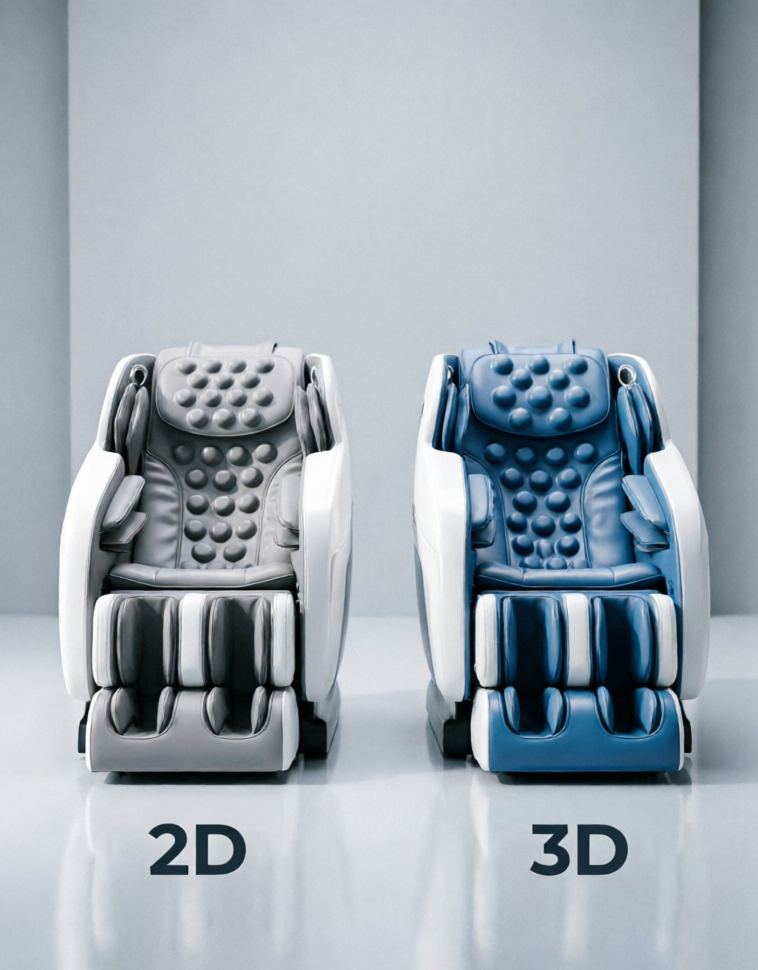
You’re shopping for a massage chair, and you keep seeing terms like 2D, 3D, and 4D rollers. They sound technical, but understanding them is the difference between buying a chair that feels like a basic vibrating seat and one that feels like a professional masseuse has moved into your living room.
In this guide, we’ll break down exactly what 2D and 3D mean, how they feel during a massage, and help you decide which technology is right for your body, your budget, and your pain relief needs.
🎯 Quick Verdict: Choose 3D if you want adjustable depth and genuine deep tissue relief — the rollers can push into your muscles for therapeutic pressure. Choose 2D if you’re on a tight budget and only want light, surface-level relaxation. For most buyers with back pain, 3D is worth the extra investment.
What Do the “Ds” Actually Mean?
The “D” in 2D and 3D stands for dimension — referring to the directions the massage rollers can move. The more dimensions, the more sophisticated and human-like the massage feels.
2D Massage: Two-Way Movement (Basic)
2D rollers move on two axes:
- Up and down (Y-axis) — along your spine
- Left and right (X-axis) — across your back
The rollers cannot adjust how deep they press into your muscles. The pressure is fixed, which is why 2D chairs often feel like a surface-level massage rather than deep tissue work .
2D technology is typically found on entry-level massage chairs and offers excellent value for first-time buyers who want general relaxation without deep tissue work .
3D Massage: Three-Way Movement (Therapeutic)
3D rollers add a third axis of movement:
- Up and down (Y-axis) — along your spine
- Left and right (X-axis) — across your back
- In and out (Z-axis) — depth/pressure control
This third dimension allows the chair to push the rollers further into your muscles for a deeper, more therapeutic massage. You can typically adjust the intensity from 1 (gentle) to 5 (deep tissue), giving you complete control over how hard the rollers press .
3D technology is the industry standard for mid-range and premium massage chairs, offering the best balance of price and performance for therapeutic relief .
Quick Comparison: 2D vs 3D at a Glance
| Feature | 2D Massage Chair | 3D Massage Chair |
|---|---|---|
| Roller movement | Up/down + left/right (2 axes) | Up/down + left/right + in/out (3 axes) |
| Depth/pressure adjustment | ❌ Fixed pressure | ✅ Adjustable (1-5 levels) |
| Deep tissue capability | ❌ Surface-level only | ✅ Genuine deep tissue |
| Customization | Basic intensity settings | Full depth & speed control |
| Best for | Light relaxation, first-time buyers | Chronic pain, deep tissue needs |
| Typical price range | $900 – $2,500 | $2,500 – $6,000+ |
How 2D Massage Feels: The Entry-Level Experience
A 2D massage chair provides a smooth, rolling sensation across your back. The rollers move up and down, and they can shift left and right, but the pressure stays constant.
What it feels like: Imagine someone rolling a tennis ball gently along your back. It’s pleasant and relaxing, but it doesn’t dig into knots or release deep tension.
Best for:
- First-time massage chair buyers
- Budget-conscious shoppers (2D chairs typically cost $900-$2,500)
- Seniors or people sensitive to deep pressure
- Light, daily relaxation and stress relief
- General muscle tension (not chronic knots)
Popular 2D models include the Lifesmart 2D Full Body Massage Chair ($1,999), which features 8 fixed i-track rollers, 30 airbags, zero gravity positioning, and Bluetooth speakers .
How 3D Massage Feels: The Therapeutic Upgrade
A 3D massage chair can push the rollers deeper into your muscles, providing genuine deep tissue relief. You can typically adjust the intensity from 1 (gentle) to 5 (aggressive), allowing you to customize each session based on how your body feels that day.
What it feels like: Imagine a skilled massage therapist using their thumbs to dig into a knot in your shoulder blade and then slowly releasing. The 3D rollers mimic this kneading action, with the ability to press deeper or shallower on command.
Best for:
- People with chronic back pain or muscle knots
- Athletes needing deep tissue recovery
- Office workers with tight shoulders and neck
- Anyone who has tried 2D and found it too light
- Households where multiple people will use the chair
Benefits of 3D technology:
- Adjustable pressure for different body types (a 120 lb person and 200 lb person need different pressure)
- Ability to target specific knots with focused depth
- Can be gentle for sensitive days or aggressive for deep recovery
- More human-like massage feel
Price Comparison: Is 3D Worth the Extra Cost?
The price difference between 2D and 3D massage chairs is significant, but so is the difference in therapeutic value.
| Technology | Price Range | Value Proposition |
|---|---|---|
| 2D Massage Chair | $900 – $2,500 | Good for light relaxation and first-time buyers |
| 3D Massage Chair | $2,500 – $6,000+ | Excellent for chronic pain and deep tissue relief |
According to iRest’s product guide, 2D models offer “excellent value and simplicity” for first-time buyers, while 3D models are specifically designed for “deep tissue and pain relief” .
The bottom line: If you have chronic back pain or need genuine therapeutic relief, the extra $1,000-$2,000 for 3D technology is money well spent. If you just want a gentle way to unwind after work and have a tight budget, 2D can still provide meaningful relaxation.
What About 4D and 5D?
You might also see 4D and 5D massage chairs as you shop. Here’s a quick overview of what comes beyond 3D:
4D Massage Adds Speed & Rhythm Variation
4D takes 3D movement and adds a variable speed component. Real humans don’t rub your back at one constant speed; they slow down at a knot and speed up during long strokes. 4D mimics this human cadence, creating an even more lifelike massage experience .
4D chairs typically cost $3,500-$6,000+ and are best for enthusiasts who want the most realistic massage possible .
5D Massage Adds AI Intelligence
5D is the newest technology (2025+), using AI sensors to measure muscle stiffness in real-time and automatically adjusting depth and speed without you touching the remote . These are luxury chairs typically costing $6,000-$10,000+.
For most buyers, 3D offers the best balance of price and performance .
How to Choose Between 2D and 3D
Choose 2D if:
- Your budget is under $2,500
- You’re a first-time buyer testing the concept
- You only want light, surface-level relaxation
- You have no chronic back pain or muscle knots
- You’re buying for a senior or someone sensitive to pressure
- You’ll use the chair 1-3 times per week
Choose 3D if:
- You have chronic back pain or muscle tension
- You want genuine deep tissue massage
- Your budget is $2,500+
- Multiple people with different body types will use the chair
- You’ve tried 2D and found it too light
- You’ll use the chair daily or 5+ times per week
Frequently Asked Questions
Can you feel the difference between 2D and 3D?
Yes — the difference is immediately noticeable. 2D massage feels like a surface-level rolling sensation. 3D massage pushes deeper into your muscles, providing genuine deep tissue relief. Most people can tell the difference within minutes of sitting in each chair.
Is 3D worth the extra money?
For most people with back pain, yes. The adjustable depth control allows you to customize pressure from gentle to aggressive, making 3D chairs versatile enough for different body types and pain levels. For chronic knot sufferers, the extra $1,000-$2,000 is well worth it for the therapeutic benefits.
Do 2D chairs have heat and zero gravity?
Yes — many 2D chairs still offer heat therapy, zero gravity recline, airbags, and foot rollers. 2D refers only to the roller movement, not the other features. For example, the Lifesmart 2D Massage Chair includes zero gravity, 30 airbags, Bluetooth speakers, and lumbar heat .
Which is better for back pain: 2D or 3D?
3D is significantly better for back pain. The ability to adjust roller depth means you can apply therapeutic pressure directly to knots and tight muscles. 2D chairs can only provide surface-level rolling, which is less effective for chronic pain relief.
What’s the difference between 2D and 3D massage chairs?
2D rollers move up/down and left/right with fixed pressure. 3D rollers add in/out movement for adjustable depth control. This third dimension allows 3D chairs to provide genuine deep tissue massage, while 2D chairs are limited to surface-level relaxation .
Final Verdict: Which Should You Buy?
🎯 Winner for Most Buyers: 3D Massage Chair
For anyone with chronic back pain, daily muscle tension, or a desire for genuine therapeutic relief, 3D technology is the clear winner. The adjustable depth control transforms your massage from a basic surface rub to a targeted deep tissue session.
🎯 Winner for Budget Buyers: 2D Massage Chair
If your budget is under $2,500 and you only want light relaxation, 2D chairs offer excellent value. They still provide heat therapy, zero gravity, airbags, and foot rollers — just without the deep tissue capability.
🎯 The Sweet Spot: 3D with SL-Track ($2,500-$4,000)
The best value in the massage chair market is a 3D chair combined with SL-Track technology. This gives you adjustable depth pressure AND full coverage from neck to hamstrings — the two most important features for therapeutic relief.
Remember: The best massage chair for you is the one that fits your budget, your space, and — most importantly — your body’s needs. If you have chronic back pain, investing in 3D technology is one of the best decisions you can make for your long-term health.
📌 Related guides: