


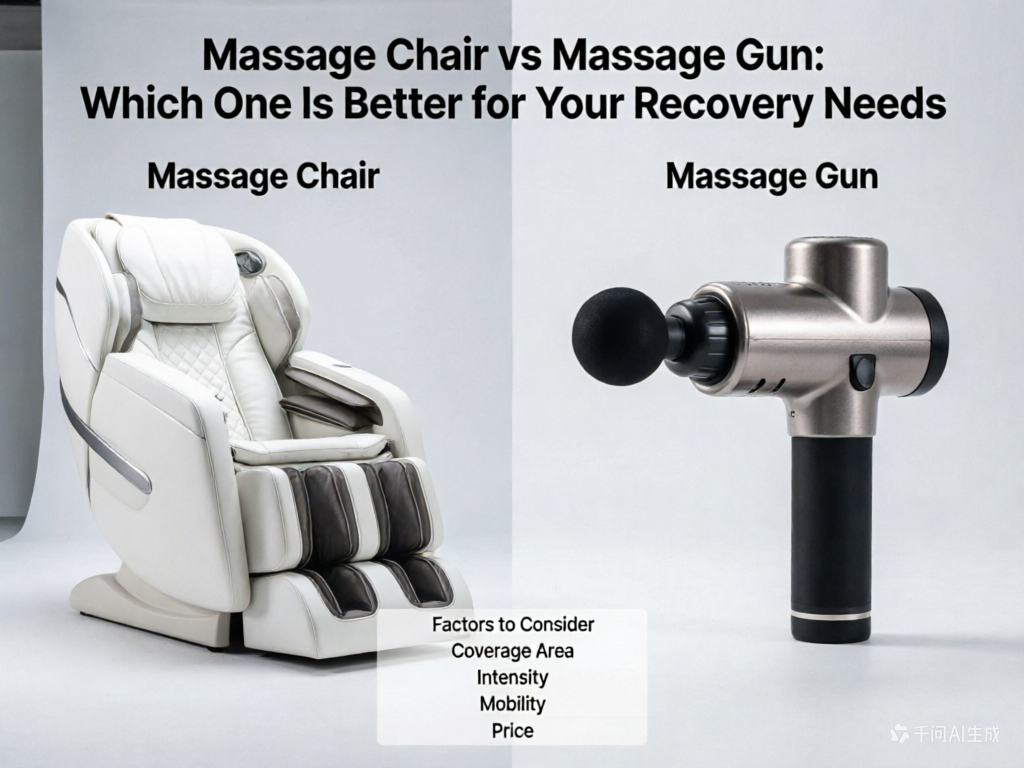
You wake up with a tight neck. Your lower back aches from sitting at a desk all day. Your quads are sore from yesterday’s workout. You need relief — but what’s the best tool for the job?
Two popular options dominate the home recovery market: massage chairs and massage guns. Both promise to ease muscle tension, improve circulation, and speed recovery. But they work in completely different ways, serve different purposes, and fit different lifestyles.
In this guide, we’ll break down everything you need to know about massage chairs vs massage guns: how they work, which one is better for specific situations, and how to decide which one (or both) belongs in your home.
🎯 Quick Verdict: Choose a massage gun for targeted deep tissue work, portability, and pre-workout activation — perfect for athletes and active individuals. Choose a massage chair for full-body relaxation, spinal decompression, and hands-free stress relief — ideal for daily unwinding and chronic tension. Many people benefit from owning both.
How Each Device Works: Different Approaches to Muscle Relief
Understanding the mechanism of each device is key to choosing the right one for your needs.
💆 Massage Chair: Full-Body Passive Therapy
A massage chair is a powered recliner built around a roller track that applies mechanical pressure along your back, glutes, and legs. Using a combination of rollers, airbags, heat, and zero-gravity positioning, it provides a hands-free, full-body massage experience.
Massage chairs use several techniques:
- Roller massage: Mechanical rollers travel along an SL-track from your neck to your hamstrings, providing kneading, tapping, and shiatsu techniques
- Airbag compression: Inflatable airbags wrap around shoulders, arms, hips, calves, and feet to provide a squeezing sensation that improves circulation
- Heat therapy: Carbon fiber heating pads in the lumbar area (and sometimes calves) loosen tight muscles before roller work
- Zero gravity recline: Elevates your legs above your heart to reduce spinal pressure by up to 80%
Massage chairs are designed for 15-30 minute sessions of passive relaxation. You sit, recline, and let the chair do all the work.
🔫 Massage Gun: Targeted Active Percussion
A massage gun (also called a percussion massager) is a handheld device that delivers rapid, repetitive pulses deep into muscle tissue. Operating at 1,700 to 3,200 revolutions per minute, these devices use percussive therapy to target specific muscle groups.
Massage guns work through:
- High-frequency percussion: The motor drives a massage head to rapidly strike and release muscle tissue, creating a vibration that penetrates deep into muscle fibers
- Amplitude (stroke length): Premium massage guns offer 12-16mm of amplitude, meaning the massage head moves that far with each pulse, reaching deeper into muscle tissue
- Stall force: Measured in pounds, this indicates how much pressure you can apply before the motor stops. Higher stall force (40-50 lbs) means deeper, more effective massage
- Interchangeable heads: Different attachments (ball, flat, bullet, fork) target different body parts and tissue types
Massage guns are designed for 2-5 minute sessions per muscle group. You actively hold and guide the device to target specific areas.
Key Differences: Massage Chair vs Massage Gun
| Feature | Massage Chair | Massage Gun |
|---|---|---|
| Coverage area | Full body (neck to feet) | Spot treatment only |
| Hands-free | ✅ Yes | ❌ No (must hold and guide) |
| Portability | ❌ No (150-250 lbs) | ✅ Yes (1-3 lbs) |
| Session length | 15-30 minutes | 2-5 minutes per muscle group |
| Price range | $500 – $12,000+ | $50 – $600 |
| Depth of penetration | Shallow (airbags & surface rollers) | Deep (8-16mm amplitude) |
| Best for | Full-body relaxation, spinal decompression | Targeted deep tissue, trigger points |
| Noise level | 45-55 dB | 50-70 dB |
| 5-year cost (3x/week) | ~$4.78 per session | ~$0.54 per session |
Effectiveness Comparison: Which One Works Better?
Deep Tissue Penetration: Massage Gun Wins
For reaching deep into muscle tissue, the massage gun has a clear advantage. Premium massage guns deliver 12-16mm of amplitude (stroke length), meaning the massage head travels over half an inch with each pulse. This allows the device to penetrate through skin, fat, and fascia to reach deep muscle fibers.
Massage chairs, by contrast, rely on rollers and airbags that typically cannot penetrate beyond surface muscle layers. Airbag compression is effective for circulation but doesn’t reach deep trigger points. The rollers, while adjustable on premium models, are limited by the chair’s track design and cannot match the focused intensity of a percussion massager.
Winner: Massage Gun — superior for deep tissue work and trigger point release.
Full-Body Coverage: Massage Chair Wins
This is where the massage chair shines. With an SL-track system, a quality massage chair covers from your neck, down your entire back, through your glutes, and to your hamstrings. Airbags add compression for your shoulders, arms, calves, and feet. Heat therapy targets your lower back. Zero gravity recline decompresses your entire spine.
A massage gun, by contrast, requires you to manually target each muscle group. You can’t reach your own back effectively without assistance. You have to hold the device, guide it to each area, and manage the pressure yourself. It’s excellent for spot treatment but impractical for full-body sessions.
Winner: Massage Chair — unmatched for full-body relaxation and coverage.
Portability and Convenience: Massage Gun Wins
Massage guns weigh 1-3 pounds and fit in a gym bag or backpack. You can use one at home, at the office, at the gym, or even on a plane. Battery life typically lasts several days to a week with regular use.
Massage chairs weigh 150-250 pounds and require dedicated floor space. Once delivered and assembled, they’re not moving. This makes them impractical for anyone who travels frequently or wants recovery tools at multiple locations.
Winner: Massage Gun — vastly more portable and convenient.
Pre-Workout Activation: Massage Gun Wins
Physical therapists increasingly recommend using massage guns as part of your warm-up routine. Using a massage gun 10-15 minutes before exercise increases blood flow to muscles, improves range of motion, and helps muscles respond better during training.
Massage chairs are designed for post-activity recovery, not pre-workout activation. While you could use one before exercise, the 15-30 minute time commitment and passive nature make them less practical for warm-ups.
Winner: Massage Gun — excellent for pre-workout activation and warm-ups.
Stress Relief and Relaxation: Massage Chair Wins
For pure relaxation and stress reduction, the massage chair is hard to beat. Zero gravity positioning reduces spinal pressure. Gentle roller movements and airbag compression create a full-body sensation of being hugged. The hands-free nature allows you to completely let go — no need to hold or guide anything.
Massage guns, while effective for muscle relief, are more clinical in nature. The percussive action is intense and requires active participation. They’re not designed for relaxation in the same way a massage chair is.
Winner: Massage Chair — superior for stress relief and passive relaxation.
Cost Per Session: Massage Gun Wins
Over a 5-year period of using the device 3 times per week, a massage gun costs about $0.54 per session (including initial purchase and battery replacement). A mid-tier massage chair costs about $4.78 per session under the same usage pattern.
However, this calculation doesn’t account for the different experiences. A massage chair session is more comprehensive and hands-free. Many users find the higher per-session cost worthwhile for the full-body relaxation they receive.
Winner: Massage Gun — significantly lower cost per use.
When to Use Each Device: A Practical Guide
Choose a Massage Gun When…
- You need targeted deep tissue work — specific knots, trigger points, or tight spots that need focused attention
- You’re an athlete — for pre-workout activation, post-workout recovery, and between-session maintenance
- You travel frequently — massage guns fit in a suitcase; massage chairs don’t
- You’re on a tight budget — quality massage guns start at $100-200
- You want something for the gym bag or office — quick relief during the workday or after a workout
- You have limited space — massage guns store in a drawer; massage chairs need dedicated floor space
- You prefer active recovery — you want to control the pressure, angle, and duration yourself
Choose a Massage Chair When…
- You want full-body relaxation — neck-to-feet coverage without lifting a finger
- You have chronic back pain — the SL-track and zero gravity positioning are specifically designed for spinal health
- You struggle with stress or sleep — the hands-free, zero-gravity experience promotes deep relaxation
- You have a dedicated space at home — living room, home theater, bedroom, or home office
- You want a daily unwinding ritual — 15-30 minutes of scheduled relaxation time
- You have disposable income for wellness — quality chairs start around $1,500-2,000
- You prefer passive recovery — you want to sit back and let the device do all the work
Can You Reach Your Own Back with a Massage Gun?
This is a common question. The honest answer: it’s difficult and often ineffective.
While you can reach your upper back and shoulders with some contortion, reaching your mid-back, lower back, and glutes is challenging. You’ll need to twist your body, which can create new tension elsewhere. Many people require a partner to use a massage gun on their back effectively.
A massage chair, by contrast, is specifically designed to reach every part of your back effortlessly. The SL-track follows your spine’s natural curve from neck to hamstrings, hitting areas you could never reach with a handheld device.
Winner for back coverage: Massage Chair
Can a Massage Gun Replace a Massage Chair?
No — they serve different purposes. A massage gun is excellent for targeted deep tissue work, pre-workout activation, and portability. A massage chair is superior for full-body relaxation, spinal decompression, and hands-free stress relief.
Think of it this way:
- Massage gun = spot treatment — like using a specialized tool to fix a specific problem area
- Massage chair = full-body wellness — like having a daily spa session at home
Many wellness enthusiasts actually own both. They use the massage gun for quick targeted relief after workouts or during the workday, and the massage chair for longer relaxation sessions in the evening.
What the Experts Say
Physical therapists and wellness experts generally agree on the complementary nature of these tools:
- Massage guns are recommended for pre-workout activation and targeted trigger point release. Using a massage gun 10-15 minutes before exercise increases blood flow and improves range of motion.
- Massage chairs are recommended for post-activity recovery and daily stress management. The zero gravity position and full-body compression promote parasympathetic nervous system activation, helping your body enter recovery mode.
For elite athletes, the optimal approach is often stacking both: a massage chair for nightly full-body recovery, and a massage gun for pre-event activation and between-session spot treatment.
Safety Considerations for Both Devices
Massage Gun Safety
- Avoid using on bone, joints, or recent injuries
- Keep away from your neck and head
- Limit use to 2-5 minutes per muscle group
- Start on the lowest setting and build up
- Don’t use on inflamed tissue (wait 48 hours after acute injury)
- Consult a doctor if you have a pacemaker, are pregnant, or have blood clotting disorders
Massage Chair Safety
- Limit sessions to 15-20 minutes
- Start with low intensity if you’re new or have sensitive tissues
- Consult a doctor if you have osteoporosis, herniated discs, blood clots, or recent surgery
- Don’t use on full stomach (wait 60 minutes after eating)
- Seniors should start with shorter sessions and lower intensity
Frequently Asked Questions
Is a massage gun better than a massage chair for back pain?
It depends on the type of back pain. For acute trigger points and knots in specific areas, a massage gun is excellent for targeted relief. For chronic, widespread back pain that involves tension across multiple areas, a massage chair’s full-back SL-track coverage and zero gravity positioning may be more effective. Many people with chronic back pain benefit from using both.
Can a massage gun be used every day?
Yes — but with moderation. Physical therapists recommend using a massage gun daily, but limit each muscle group to 2-5 minutes. Overuse can irritate muscle tissue rather than help it recover. Using it before workouts (10-15 minutes) is safe and beneficial.
How long should I use a massage chair?
Most experts recommend 15-20 minute sessions, 1-2 times daily. Longer sessions can overstimulate muscles and lead to soreness. Start with 10-15 minutes at low intensity if you’re new to massage chairs.
Which is more affordable: massage chair or massage gun?
Massage guns are significantly more affordable upfront. A quality massage gun costs $100-400, while an entry-level therapeutic massage chair starts around $1,500-2,000. Over 5 years of regular use, a massage gun costs about $0.54 per session compared to $4.78 per session for a massage chair.
Can a massage gun help with sciatica?
Yes — but carefully. Massage guns can help release tight gluteal muscles that compress the sciatic nerve. Use a low setting with a soft attachment head, avoid direct pressure on the nerve pathway, and limit to 1-2 minutes. Consult a doctor before using a massage gun for sciatica, as improper use can worsen symptoms.
Do I need both a massage chair and a massage gun?
Many people benefit from owning both. They serve different purposes: the massage gun for targeted, portable relief and pre-workout activation; the massage chair for full-body relaxation and spinal decompression. If your budget allows, having both tools gives you complete recovery coverage for all situations.
Final Verdict: Massage Chair vs Massage Gun
🎯 Winner for Targeted Deep Tissue: Massage Gun
Superior for reaching deep muscle fibers, releasing trigger points, and pre-workout activation. More portable and affordable. Best for athletes, active individuals, and anyone needing spot treatment.
🎯 Winner for Full-Body Relaxation: Massage Chair
Unmatched for hands-free, full-body coverage including spinal decompression and zero gravity positioning. Best for chronic back pain, stress relief, and daily unwinding rituals.
🎯 Winner for Most Households: Both (if budget allows)
These tools complement rather than compete with each other. The massage gun handles targeted spot work and portability; the massage chair handles full-body relaxation and spinal health. If you can only afford one, choose based on your primary need: spot treatment → massage gun; full-body relaxation → massage chair.
Remember: The best recovery tool is the one you’ll actually use consistently. A $100 massage gun used daily is better than a $5,000 massage chair that sits unused. Consider your lifestyle, space, budget, and primary needs before making a decision.
📌 Related guides: