


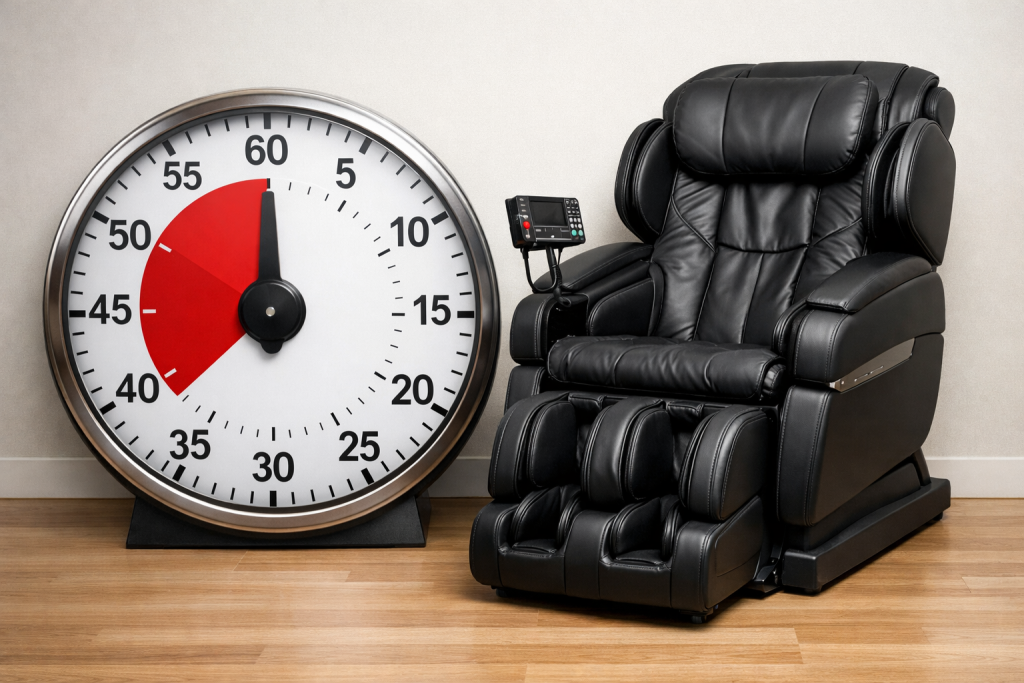
How Long Should You Use a Massage Chair Each Day? A Complete Guide to Safe Usage
You just bought a new massage chair. It feels amazing. The natural temptation? Stay in it for an hour or more.
But is that safe? The question every new owner asks is: how long should you use a massage chair each day?
In this complete guide, we’ll give you the exact answer based on expert recommendations, explain why moderation matters, and show you how to avoid common overuse problems like muscle soreness and fatigue.
The Short Answer: 15–20 Minutes Per Session, 1–2 Times Daily
Most massage chair manufacturers, chiropractors, and physical therapists agree on the same range: 15 to 20 minutes per session, with a maximum of 1 to 2 sessions per day.
That’s it. Simple. But why this specific number? Let’s break down the science.
Why 15–20 Minutes? The Science Behind the Recommendation
1. Your Muscles Need Time to Adapt — But Not Too Much
Massage works by applying pressure to muscle tissue, which increases blood flow and releases tension. However, after about 15–20 minutes, your muscles begin to fatigue from repeated compression. Beyond this point, the benefits diminish and the risks increase.
2. Circulation Peaks at 15 Minutes
Research shows that blood flow increases significantly within the first 10–15 minutes of mechanical massage. After that, circulation remains elevated but additional time doesn’t add proportional benefit. You get the maximum return on investment at 15–20 minutes.
3. Nervous System Response
Massage activates the parasympathetic nervous system (“rest and digest”), which lowers heart rate and blood pressure. This is great for relaxation. But extended sessions can overstimulate this response, leading to excessive drowsiness, lightheadedness, or even nausea.
🧠 Key insight: Think of massage chair use like exercise. A 20-minute workout is beneficial. A 60-minute workout without rest can lead to injury. The same principle applies to massage.
What Happens If You Use a Massage Chair Too Long? (Risks of Overuse)
Using a massage chair for 30–60 minutes or more in a single session can trigger several negative effects.
1. Muscle Soreness (The Most Common Complaint)
Instead of relaxing your muscles, overuse can cause micro-trauma to muscle fibers. This is the same mechanism behind delayed onset muscle soreness (DOMS) after a hard workout. Symptoms include:
- Increased stiffness the next day
- Tenderness when touching the massaged area
- Pain that feels like a “bruise” deep in the muscle
2. Fatigue and Brain Fog
Massage lowers cortisol (stress hormone) and blood pressure. While this is usually positive, too much can leave you feeling:
- Excessively drowsy (dangerous if you need to drive)
- Mentally sluggish for hours
- Lacking energy for daily activities
3. Bruising and Skin Irritation
People with sensitive skin, low platelet counts, or those taking blood thinners may notice bruising after long sessions. The mechanical action of rollers and airbags can also cause friction burns or redness.
4. Nerve Compression or Tingling
Prolonged pressure on specific areas — especially the sciatic nerve (lower back/glutes) or ulnar nerve (elbow/arm) — can cause temporary numbness, tingling, or a “pins and needles” sensation. This usually resolves within hours but is a sign you’ve overdone it.
5. Joint Hypermobility Issues
Excessive vibration and mobilization can temporarily loosen ligaments around joints. For most people this isn’t a problem, but if you have Ehlers-Danlos syndrome, ligament laxity, or frequent dislocations, long sessions can worsen instability.
6. Rebound Tension
Paradoxically, over-massaging can cause muscles to tighten back up as a protective response. This “rebound tension” leaves you feeling worse than before you started.
Daily Usage Limits by User Type
Not everyone has the same tolerance. Here’s how recommended usage varies by individual factors:
| User Type | Max Per Session | Max Per Day | Intensity Level |
|---|---|---|---|
| Healthy adult (no pain) | 20 min | 2x | Medium |
| Chronic back pain (muscle-related) | 15 min | 2x | Low to Medium |
| Elderly (65+ years) | 10–15 min | 1x | Low |
| Athletes (post-workout) | 15 min | 1–2x | Medium to High (on muscles only) |
| Pregnant women (with doctor approval) | 10 min | 1x | Very Low (no airbags on belly) |
| People with osteoporosis | 10 min | 1x (every other day) | Very Low (vibration only) |
Best Practices for Safe and Effective Daily Use
Follow these 8 rules to get the most from your massage chair without risking overuse injuries.
✅ 1. Stay Hydrated — Before AND After
Massage releases metabolic waste (lactic acid, toxins) from your muscles. Without enough water, these waste products can recirculate and cause soreness.
- Drink 8–12 ounces of water within 30 minutes before your session
- Drink another 8–12 ounces immediately after
- Avoid alcohol and caffeine for 2 hours before/after (they dehydrate)
✅ 2. Adjust Intensity to Your Comfort Level
More pressure is NOT always better. In fact, most people use intensity levels that are too high.
- Start at 20–30% of maximum intensity if you’re new
- Increase gradually over 2–3 weeks
- If you’re flinching or holding your breath, it’s too intense
✅ 3. Use the Body Scan Feature (If Available)
Modern chairs have automatic body scanning that maps your spine and shoulder position. This ensures rollers hit muscles — not bone. Run the scan every time you sit down, especially if multiple people use the chair.
✅ 4. Don’t Use the Same Program Every Day
Your muscles adapt to repetitive motion. Rotate between:
- Kneading (for deep tissue)
- Rolling (for spine mobility)
- Tapping (for surface circulation)
- Shiatsu (for pressure points)
✅ 5. Take Breaks Between Sessions
If you want 30–40 minutes total, split it into two 15–20 minute sessions with at least 2–3 hours in between. This gives your muscles time to recover and prevents overstimulation.
✅ 6. Listen to Pain Signals — Stop Immediately If…
A good massage feels like “good pain” — the satisfying ache of a tight knot releasing. But stop right away if you feel:
- 🚩 Sharp, shooting, or stabbing pain
- 🚩 Sudden numbness or “pins and needles”
- 🚩 Dizziness, nausea, or headache
- 🚩 Pain that radiates down your arm or leg
✅ 7. Don’t Use on Full Stomach
Massage stimulates digestion and can cause nausea if you’ve just eaten. Wait at least 60 minutes after a meal before using the chair.
✅ 8. Keep a Usage Log for the First Month
Track your sessions to find your personal sweet spot. Record:
- Date and time
- Duration and intensity
- How you felt immediately after
- How you felt the next morning
This data will help you adjust your routine for maximum benefit with zero side effects.
Signs You’re Using Your Massage Chair Too Much
Even if you’re following the 15–20 minute rule, you might still be overdoing it if you use it too many days in a row. Watch for these warning signs:
- 😣 You feel more sore the day after using the chair (not less)
- 😴 You feel excessively tired or mentally foggy for hours
- 🩸 You notice bruising in areas the chair targeted
- 🦵 You have tingling or numbness that lasts more than 30 minutes after the session
- 😤 You feel irritable or restless (overstimulation of the nervous system)
If you experience any of these, take 2–3 days off from the chair. When you return, reduce session time to 10 minutes and lower the intensity by 50%.
Can You Use a Massage Chair Every Day?
Yes — for most healthy adults, daily use is perfectly safe as long as you stick to the 15–20 minute limit and take at least one rest day per week.
In fact, daily short sessions are often more effective than longer sessions every other day. Consistency trains your muscles to stay relaxed, rather than bouncing between tight and loose states.
However, if you’re new to massage chairs, start with 3–4 times per week for the first two weeks. Then increase to daily if you feel no negative effects.
Special Considerations for Specific Conditions
Chronic Lower Back Pain
Use 10–15 minutes daily with low intensity. Focus on the lumbar area with heat turned on. Avoid direct pressure on the spine itself.
Sciatica
Shorter sessions (10 minutes) are better. Use gentle rolling — never deep kneading — on the glutes and hamstrings. Stop immediately if pain radiates down your leg.
Herniated or Bulging Disc
Do not use a massage chair without doctor approval. If approved, use only 5–10 minutes at very low intensity on muscles away from the spine (e.g., shoulders only).
Pregnancy
Only use during second and third trimesters with OB/GYN approval. Limit to 10 minutes, avoid airbags on the belly, and never lie flat (use zero gravity recline).
Fibromyalgia
Start with 5 minutes only at the lowest intensity. Fibromyalgia patients often have extreme sensitivity to pressure. Increase slowly over 4–6 weeks.
⚠️ Medical disclaimer: If you have any diagnosed medical condition — especially spinal issues, blood clots, neuropathy, or osteoporosis — consult your doctor before using a massage chair. This article is for informational purposes and does not replace professional medical advice.
Massage Chair vs. Human Massage Therapist: Duration Differences
Why can a human massage therapist work on you for 60–90 minutes, but a massage chair should be limited to 20 minutes?
| Factor | Massage Chair | Human Therapist |
|---|---|---|
| Feedback loop | None (mechanical) | Real-time adjustments based on your reactions |
| Pressure variation | Pre-programmed | Constantly changing based on muscle response |
| Targeting accuracy | Good (with body scan) | Excellent (palpation and anatomy knowledge) |
| Safe max duration | 15–20 minutes | 60–90 minutes |
Key takeaway: A human therapist can adjust pressure in real-time based on your breathing, facial expressions, and verbal feedback. A massage chair follows a fixed program. That’s why chair sessions must be shorter.
What About Using a Massage Chair Multiple Times Per Day?
Two sessions per day (morning + evening) is safe for most people, as long as each session stays under 20 minutes and you have at least 4–6 hours between sessions.
Example safe schedule:
- 🌅 Morning (10 minutes): Wake-up program — gentle tapping and rolling to increase circulation
- 🌙 Evening (15 minutes): Deep kneading + heat to release daily tension before sleep
Three or more sessions per day is not recommended for anyone except under professional supervision (e.g., athletes in intensive training).
How to Build Your Perfect Daily Massage Routine
Here’s a sample 4-week progression plan:
Week 1 (Acclimation):
10 minutes • Low intensity • 3–4 days/week
Focus: Learn the controls, test different programs
Week 2 (Building tolerance):
12–15 minutes • Low to medium intensity • 5 days/week
Focus: Add heat therapy, try zero gravity position
Week 3 (Optimization):
15 minutes • Medium intensity • 6 days/week
Focus: Rotate between 3 different programs
Week 4 (Full routine):
15–20 minutes • Medium to varied intensity • Daily (with 1 rest day)
Focus: Morning short session + evening longer session (2x/day max)
Frequently Asked Questions
Can I fall asleep in my massage chair?
Not recommended. Falling asleep can lead to 60+ minute sessions, which significantly increases risks of soreness, bruising, and nerve compression. Set a timer on your phone if you tend to doze off.
Is 30 minutes too long in a massage chair?
For most people, yes, 30 minutes is too long in a single session. If you want 30 minutes total, split it into two 15-minute sessions with a break in between.
Can children use massage chairs?
Children under 12 should use massage chairs for 5–10 minutes maximum at very low intensity, and only with adult supervision. Their developing bones and muscles are more sensitive to pressure.
Does using a massage chair every day have long-term benefits?
Yes. Studies show that daily short massage sessions can lead to sustained reductions in chronic pain, improved sleep quality, lower stress hormones, and better posture over 6–12 months.
Why do I feel sore the day after using my massage chair?
You either used it too long (over 20 minutes), at too high intensity, or you’re new to massage and your muscles aren’t adapted yet. Take 2 days off, then return with 10 minutes at low intensity.
Conclusion: Moderation Is Key to Safe and Effective Use
So, how long should you use a massage chair each day? The evidence-based answer is clear:
🎯 15–20 minutes per session, 1–2 times daily, with at least one rest day per week.
Staying within these limits gives you all the benefits — reduced muscle tension, better circulation, lower stress — while avoiding the downsides of overuse: muscle soreness, fatigue, bruising, and nerve compression.
Remember these three rules for life:
- Hydrate before and after every session
- Listen to your body — pain is a signal to stop
- Consistency beats intensity — short daily sessions work better than long weekly ones
Your massage chair is an investment in your health. Use it wisely, and it will serve you well for years to come.
📌 Related guides: