


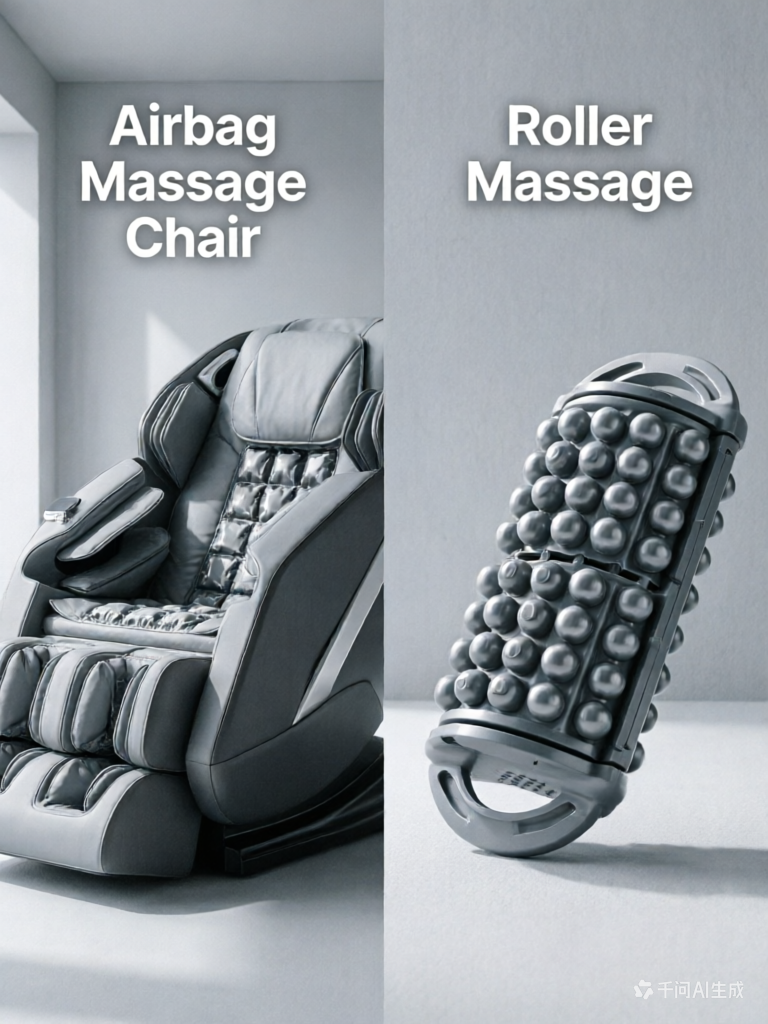
When you start shopping for a massage chair, you will encounter two primary massage technologies: roller massage and airbag massage. Some chairs rely heavily on one, while premium models combine both. But which one is right for your body and your pain relief needs?
The short answer: Rollers provide deep tissue work for your back; airbags provide compression massage for areas rollers cannot reach. The best massage chairs use both technologies together. In this guide, we will explain how each technology works, compare their effectiveness, and help you choose the right balance for your needs.
🎯 Key Takeaway: Roller massage is superior for deep tissue back work, knot relief, and spinal alignment. Airbag massage excels at compression for arms, legs, hips, and feet — areas rollers cannot effectively reach. The best chairs combine both technologies for complete full-body relief.
How Roller Massage Works
Roller massage is the core technology of any serious massage chair. Mechanical rollers move along tracks inside the chair back, simulating the kneading, tapping, and pressing techniques of a human massage therapist.
According to How It Works magazine, “rollers move in defined patterns within the chair’s frame. These rollers are designed to simulate the movement of human hands on different muscles. In some more advanced chairs, these rollers can move in multiple directions or even in circles. These rollers are usually applied only to the person’s back, as they are designed to run along predefined paths.”
Modern roller technology comes in several levels:
- 2D Rollers: Move up/down and left/right with fixed pressure. Basic but effective for light massage.
- 3D Rollers: Add depth control (in/out movement), allowing you to adjust how deep the rollers press into your muscles.
- 4D Rollers: Add speed and rhythm variation, creating a more natural, human-like massage experience.
The most common type is the quad roller, which uses four points of contact to replicate the feel of the human hand. Older models still use dual rollers, but quad roller technology is now standard on most quality chairs.
What Rollers Do Well ✅
- Deep tissue work: Rollers can dig into knots and release chronic muscle tension
- Spinal alignment: Following the natural curve of your spine promotes better posture
- Glute and hamstring coverage: SL and L-tracks extend into the seat area
- Customizable intensity: 3D/4D rollers let you adjust pressure from gentle to aggressive
- Targeted relief: Spot massage functions focus on specific problem areas
What Rollers Cannot Do ❌
- Massage arms effectively: Rollers cannot reach your arms or hands
- Compress legs and feet: Rollers only work on your back and glutes
- Provide wrapping compression: The squeezing sensation requires airbags
- Perform stretching programs: Airbags are needed to hold body parts during stretches
How Airbag Massage Works
Airbag massage systems were first introduced in massage chairs in 1995 and have become an essential feature in virtually every modern chair. The system works through a built-in compressor that creates pressure and distributes air via electro-valves to individual cushions strategically placed throughout the chair.
The airbags inflate and deflate in specific sequences to create compression massage. As one expert explains, “airbags stored in the arms and other motors tap or press into specific parts of the body. The airbags inflate and deflate to squeeze the arms and legs gently, while the motors can create a tapping sensation.”
There are four main airbag massage techniques:
- Holding: Sustained compression, primarily used during stretching programs
- Kneading: Alternating inflation and deflation that mimics kneading
- Pulsing: Higher frequency inflation/deflation for stimulating circulation
- Alternating: Sequential inflation between different airbag zones
According to rest lords, “The airbags in the massage chairs, through contraction-diastole, perform their most important task, namely to stimulate lymph flow and improve blood circulation. Muscles are better oxygenated and recover more quickly (especially after physical exertion), and blood pressure in the body is lowered. As a result, the detoxification process, i.e. the cleansing of the body of accumulated toxins, is assisted.”
What Airbags Do Well ✅
- Arm and hand massage: Airbags wrap around arms to provide compression
- Leg and calf compression: Improves circulation and reduces fatigue
- Foot massage: Often combined with foot rollers for complete relief
- Hip and glute compression: Holds hips in place for deeper roller penetration
- Stretching programs: Airbags hold body parts during stretches
- Circulation improvement: Helps flush metabolic waste from muscles
What Airbags Cannot Do ❌
- Deep tissue work: Airbags provide compression, not deep kneading
- Spinal alignment: Cannot follow spine curvature like rollers
- Targeted pressure points: Airbags affect entire zones, not specific spots
- Replace rollers for back massage: Airbags are complementary, not a replacement
How They Work Together: The Dream Team
The best massage chairs combine both technologies. As one manufacturer notes, “the 4D mechanical massage rollers with an SL track deliver a truly deep, full-body massage. The 4D rollers move smoothly from your neck to your thighs, while the airbags provide targeted compression massage for areas the rollers can’t reach.”
Here is how rollers and airbags complement each other:
| Body Area | Primary Technology | Secondary Technology |
|---|---|---|
| Back and Neck | Rollers (2D/3D/4D) | Airbags for posture positioning |
| Shoulders | Airbags (wrapping compression) | Rollers at track endpoints |
| Arms and Hands | Airbags | — |
| Hips and Glutes | Rollers (SL/L-track) + Airbags | Airbags hold hips for deeper roller penetration |
| Legs and Calves | Airbags | — |
| Feet | Rollers (foot wells) + Airbags | Airbags hold feet against rollers |
Hip Airbags: A Special Case
Hip airbags deserve special mention because their function is often misunderstood. According to Dr. Alan Weidner of Massage-Chair-Relief.com, hip airbags serve a specific purpose: they inflate to hold the hips in place so that when the rollers go down your back, it creates traction and allows the rollers to dig deeper.
When the rollers come down your back without hip airbags, they can push your body forward out of the seat. Hip airbags hold you in place, giving you a more intense lower back massage. Some advanced chairs use asymmetrical hip airbag inflation to create a shearing motion that moves your hips across the rollers, providing a different therapeutic effect.
Not all massage chairs have hip airbags, but they are a valuable feature for anyone seeking deep lower back relief.
Does the Number of Airbags Matter?
The number of airbags alone does not determine the quality of the massage. Their arrangement and coverage areas are far more important.
Some premium chairs have as many as 87 airbags, enabling sophisticated automatic programs and precise zone control. However, even chairs with fewer airbags can deliver excellent compression massage if the airbags are strategically placed.
What matters more is:
- Which body parts are covered — Look for shoulder, arm, hip, calf, and foot coverage
- Adjustable intensity — The ability to dial pressure up or down
- Zoning control — Independent adjustment for upper and lower body
- Integration with rollers — How well airbags complement the roller massage
Advanced chairs offer independent adjustment for up to 9 separate zones: shoulders, arms, back, waist, hips, thighs, calves, foot arch, and heel. This level of customization ensures that leg massage can have different intensity than back massage, or you can turn off foot massage entirely while leaving hand massage active.
Adjustable Intensity: A Critical Feature
Regardless of which technology you prefer, adjustability is essential. As Massage Chair Planet explains, “everyone enjoys a different massage and on top of that, we enjoy different massages at different times based on our needs in the moment.”
Chairs adjust intensity in two primary ways:
Via Airbags: In some chairs, airbags are located on either side of the rollers. When you increase roller intensity, the airbags deflate so your body sits closer to the rollers. When you decrease intensity, the airbags inflate to push your body further away. For compression massage, intensity is controlled by the amount of air in each bag.
Via Rollers: In chairs with 3D or 4D rollers, the rollers physically move forward and backward to increase or decrease pressure. This is a major advantage of 3D/4D technology over basic 2D rollers.
When your muscles are not yet accustomed to massage, it is wise to start with the lowest intensity. Over time, as your body becomes accustomed to the pressure, you can gradually increase the intensity.
Which Technology Is Right for You?
Choose a Roller-Heavy Chair if:
- You have chronic back pain or muscle knots that need deep tissue work
- You want spinal alignment and posture correction benefits
- You need glute and hamstring coverage (look for SL or L-track)
- You prefer manual control over pressure and targeting
- Your primary pain areas are your back, neck, and shoulders
Choose an Airbag-Heavy Chair if:
- You want full-body compression including arms, legs, and feet
- You have circulation issues or leg swelling
- You stand all day and need leg and foot relief
- You prefer gentle, wrapping compression over deep kneading
- You want stretching programs that require airbags to hold body parts
Choose a Balanced Chair (Rollers + Airbags) if:
- You want comprehensive full-body massage from head to toe
- You have multiple pain areas (back + legs + arms)
- You want the best of both technologies
- Your budget allows for a mid-range to premium chair ($2,000+)
Common Misconceptions
Misconception #1: “More airbags = better massage”
False. While more airbags enable more sophisticated programs, a well-designed chair with 30 strategically placed airbags can outperform a poorly designed chair with 80 airbags. Quality of placement matters more than quantity.
Misconception #2: “Airbags can replace rollers for back massage”
False. Airbags provide compression but cannot perform the kneading, tapping, and rolling motions that rollers deliver. For deep back relief, you need rollers. Airbags are complementary, not a replacement.
Misconception #3: “2D rollers are obsolete”
Not necessarily. While 3D/4D rollers offer more customization, 2D rollers still provide effective massage at a lower price point. They are fine for light to medium pressure needs and budget-conscious buyers.
Comparison Table: Roller vs Airbag Massage
| Feature | Roller Massage | Airbag Massage |
|---|---|---|
| Primary areas | Back, neck, glutes, hamstrings | Shoulders, arms, hips, calves, feet |
| Depth of pressure | Deep tissue capable (3D/4D) | Compression only, surface level |
| Knot relief | Excellent | Poor |
| Circulation improvement | Good | Excellent |
| Stretching support | None | Essential for holding body parts |
| Spinal alignment | Excellent (SL/L-track) | None |
| Arm/hand coverage | Poor | Excellent |
| Leg/foot coverage | Poor (except foot rollers) | Excellent |
Frequently Asked Questions
Which is better: airbag or roller massage?
Neither is “better” — they serve different purposes. Rollers are superior for deep back work and knot relief. Airbags excel at arm, leg, and foot compression. The best massage chairs use both technologies together for complete full-body relief.
Do massage chairs with only airbags exist?
Yes, but they are less common. Some basic chairs rely solely on airbag compression. However, these chairs cannot provide deep back massage. For genuine therapeutic relief, look for chairs with both rollers and airbags.
How many airbags do I need?
The number is less important than coverage. A good chair should have airbags for shoulders, arms, hips (optional), calves, and feet. Premium chairs have 30-50+ airbags, but quality placement matters more than quantity.
Can airbags replace a foot massage?
No — foot rollers are superior. Airbags provide compression, but rotating foot rollers deliver deeper reflexology massage. The best chairs combine foot rollers with airbags that hold your feet in place.
Is airbag massage good for circulation?
Yes — excellent. Airbag massage is specifically designed to stimulate lymph flow and improve blood circulation. Muscles are better oxygenated and recover more quickly, and blood pressure is lowered. This is especially beneficial for people who stand all day or have leg swelling.
Final Verdict: Which Technology Should You Prioritize?
🎯 For Back Pain Relief: Prioritize Rollers (3D/4D with SL-Track)
Rollers are essential for deep tissue work, knot relief, and spinal alignment. Look for 3D or 4D rollers with SL or L-track coverage to reach your glutes and hamstrings.
🎯 For Full-Body Relaxation: Prioritize Airbags
Airbags provide compression massage for arms, legs, hips, and feet — areas rollers cannot effectively reach. Look for chairs with comprehensive airbag coverage including shoulders, arms, calves, and feet.
🎯 For Most Buyers: Choose Both (Rollers + Airbags)
The best massage chairs combine both technologies. Rollers work your back while airbags compress your limbs and feet. This is the complete package for true full-body relief.
Remember: The best massage chair for you is one that includes both roller and airbag technologies, with 3D/4D rollers for your back and comprehensive airbag coverage for your limbs. A chair that does both will provide the most complete therapeutic experience.
📌 Related guides: